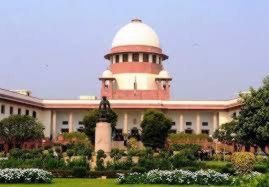
The Supreme Court on Monday asked all states and union territories to provide details of terror and narcotics cases being probed by Central and state agencies, including the NIA and the NCB, as a step towards setting up special exclusive courts for early disposal of the cases.
The top court asked the Centre to consider providing funds of Rs 1 crore each for setting up the courts in all states and UTs to prosecute cases lodged under the UAPA (the Unlawful Activities [Prevention] Act) and the NDPS Act (the Narcotic Drugs and Psychotropic Substances Act).
A bench comprising Chief Justice Surya Kant and Justice Joymalye Bagchi also asked Additional Solicitor General Aishwarya Bhati, appearing for the Centre, to consider releasing Rs 1 crore annually for ensuring smooth functioning of the special courts.
The suo motu case was fixed for further hearing on May 8.
On March 24, the apex court directed the establishment of special courts for cases investigated by the National Investigation Agency and those falling under the UAPA. Expanding the ambit, the CJI on Monday asked advocate generals of 17 states to furnish the details of cases lodged under the UAPA and the NDPS Act, irrespective of whether they are prosecuted by the NIA or the state police and by Narcotics Control Bureau or by state agencies.
The bench highlighted that early disposal would balance the rights of the accused and victims both.
The bench also issued notices to the remaining states and asked them to furnish the requisite information.
The suo motu petition was initiated following concerns that NIA trials were languishing for years.
The court noted that in many of the 17 high pendency states, including Delhi, Maharashtra, Gujarat, Bihar and Jammu and Kashmir, special courts were overburdened because presiding officers were also assigned non-NIA cases.
“NIA Courts should exclusively deal with UAPA or other related trials and such Presiding Officers should not be entrusted with any other cases,” the bench said.
A Ministry of Home Affairs (MHA) Office Memorandum of January 7, 2026 outlined a robust financial framework for these courts. It said the Central government will provide an annual grant of up to Rs 1 crore per court for staff salaries and office expenses.
It also provided for one-time non-recurring limit of Rs 1 crore for infrastructure renovation, IT equipment (computers, broadband, etc.), and furniture.
The MHA had said each court will follow a specific “model staff pattern”, including a special judge, stenographers and a dedicated driver with a vehicle for the presiding officer.
The bench had identified 17 states where more than 10 NIA trials are currently pending. The 17 states are Assam, Bihar, Chhattisgarh, Delhi, Gujarat, Jammu & Kashmir, Jharkhand, Karnataka, Kerala, Maharashtra, Manipur, Punjab, Tamil Nadu, West Bengal, Andhra Pradesh, Rajasthan, and Telangana. They agreed to set up at least one exclusive court as a pilot project.
The bench further directed the chief justices of the respective high courts to fast-track the appointment of judges with “fair and reasonable experience in conducting criminal trials”.