
A series of intensive training and demonstration programmes on scientific beekeeping were conducted across Eastern Nagaland districts under the National Bee Board–National Beekeeping and Honey Mission (NBB-NBHM), with the objective of strengthening farmer capacities, promoting scientific apiculture practices, enhancing livelihood opportunities and improving productivity in oilseed crops through organised beekeeping.
According to a press release from NU PRO, the programme was funded by the National Bee Board (NBB), Ministry of Agriculture and Farmers Welfare, Government of India, under the scheme National Beekeeping and Honey Mission (NBHM), and implemented by the School of Agricultural Sciences, Nagaland University (NU), Medziphema Campus. The project was led by Associate Professor and Principal Investigator (PI), Dr. Mary N. Odyuo, with Scientist, AICRP on Honey Bee and Pollinators, Dr. Avinash Chauhan, as Co-Principal Investigator (Co-PI). Both served as Course Directors of the training programme.
The training programmes, held from January 19 to 27, 2026 covered villages including Nokyan, Kusong, Sanglao, Pathso and Panso Headquarters in Noklak district; and Yakor, Shamator Headquarters, Sangphur and Leankonger in Shamator district.
This marked the first-ever scientific beekeeping training at village level, except for Yakor Village, locally known as the district’s “honey bee village,” where a significant proportion of households were already engaged in beekeeping.
Participants were primarily members of Farmer Producer Organisations (FPOs) supported by the Small Farmers’ Agribusiness Consortium (SFAC). The programme received technical support from officials of the Nagaland Honey Bee Mission, with sessions conducted in the presence of officials from District Agriculture and Horticulture Offices. At Leankonger Village, SDO (Civil) Bodi Kapfo joined the team for one of the training days.
Hands-on demonstrations were led by scientifically trained bee experts and state-level awarded apiculturists, covering colony inspection, seasonal management, disease identification, swarm handling and hygienic honey harvesting. Special emphasis was placed on hygienic harvesting of quality honey to maintain purity, improve shelf life and enhance market value, while reinforcing lessons on crop pollination and the role of bees in oilseed productivity.
Farmers expressed satisfaction with the training, noting improved understanding of bee behaviour, colony health and pollination benefits. They also highlighted the need for continued training, better equipment and sustained technical support to enhance productivity and income generation.
The impact was evident as participants began constructing scientific bee boxes using newly acquired skills. In Kusong Village, ten participants formed a group for joint scientific beekeeping, pooling resources to build eight-frame bee boxes—a collective effort reflecting strong motivation, cooperation and confidence in adopting scientific apiculture.
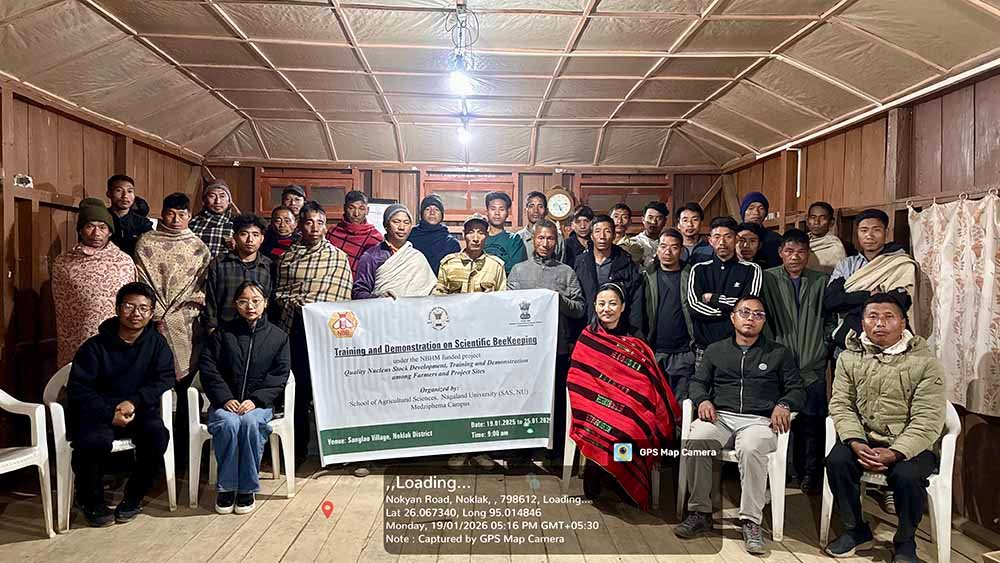
Scientific beekeeping trg conducted across Eastern Nagaland districts
DIMAPUR