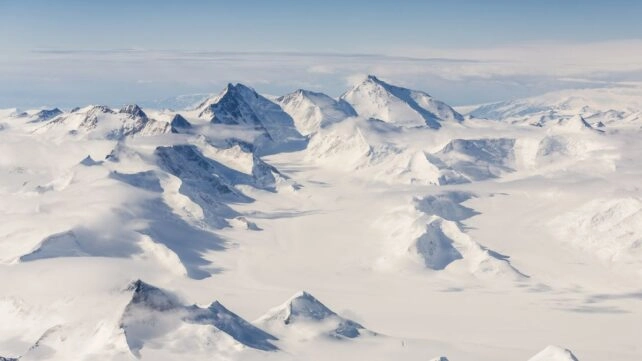
At the world’s southernmost reaches, the land is buried under a layer of ice that can reach thousands of meters thick.
Whatever lies underneath has lain concealed for millions of years – an ancient landscape of towering mountains and plunging chasms, lost below a frozen sea of white.
Decades of radar surveys and other geophysical observations have gradually revealed this mysterious buried world, and researchers have now pieced together evidence for a hidden structure on an extraordinary scale.
Beneath East Antarctica, a team led by geophysicist Egidio Armadillo of the University of Genoa has identified an enormous, fan-shaped province of about 30 connected basins.
It widens toward the coast, as though someone had taken a corner of Antarctica and tugged it apart around a central inland pivot point.
The researchers have named it the East Antarctic Fan-Shaped Basin Province (EAFBP), and they propose that it formed before the breakup of the Gondwana supercontinent, creating a zone of weakness that may later have helped steer the separation of Antarctica and Australia.
And it may still be shaping Antarctica to this day.
“Because these basins underlie about half of the East Antarctic Ice Sheet, they are likely to heavily influence both ice-flow and landscape evolution, making them essential to Antarctic glacial and hydrological processes,” the researchers write in their paper.
The question about the shape of the land underlying Antarctica isn’t purely an academic one.
That’s partially because the ice isn’t just sitting there; it’s moving, glacially, and that movement is guided by the contours of the bedrock. We can better predict the speed and direction of the flow if we have a detailed understanding of those contours. The other big reason is that it’s a huge piece of Earth’s terrestrial history.
It makes up about 10 percent of Earth’s landmass, and many questions about Gondwana, continental breakup, ancient mountain building, and crustal evolution have an Antarctica-shaped hole in them because we can’t directly see most of the continent. Interestingly, the researchers did not set out to find a fan-shaped geological structure spanning a substantial proportion of Antarctica.
Rather, they were investigating what East Antarctica would look like if the ice were removed – which is not the same thing as what the radar images show under the ice.
There are an estimated 27 million cubic kilometers of ice covering Antarctica, and it’s not just sitting there. All that mass pushes the bedrock downward. If the ice disappeared, the land would bounce upward, gaining as much as a kilometer (0.6 miles) in altitude.
The researchers combined reconstructed rebound topography with radar, gravity, seismic, and magnetic data to investigate the buried landscape. (Yahoo News)