
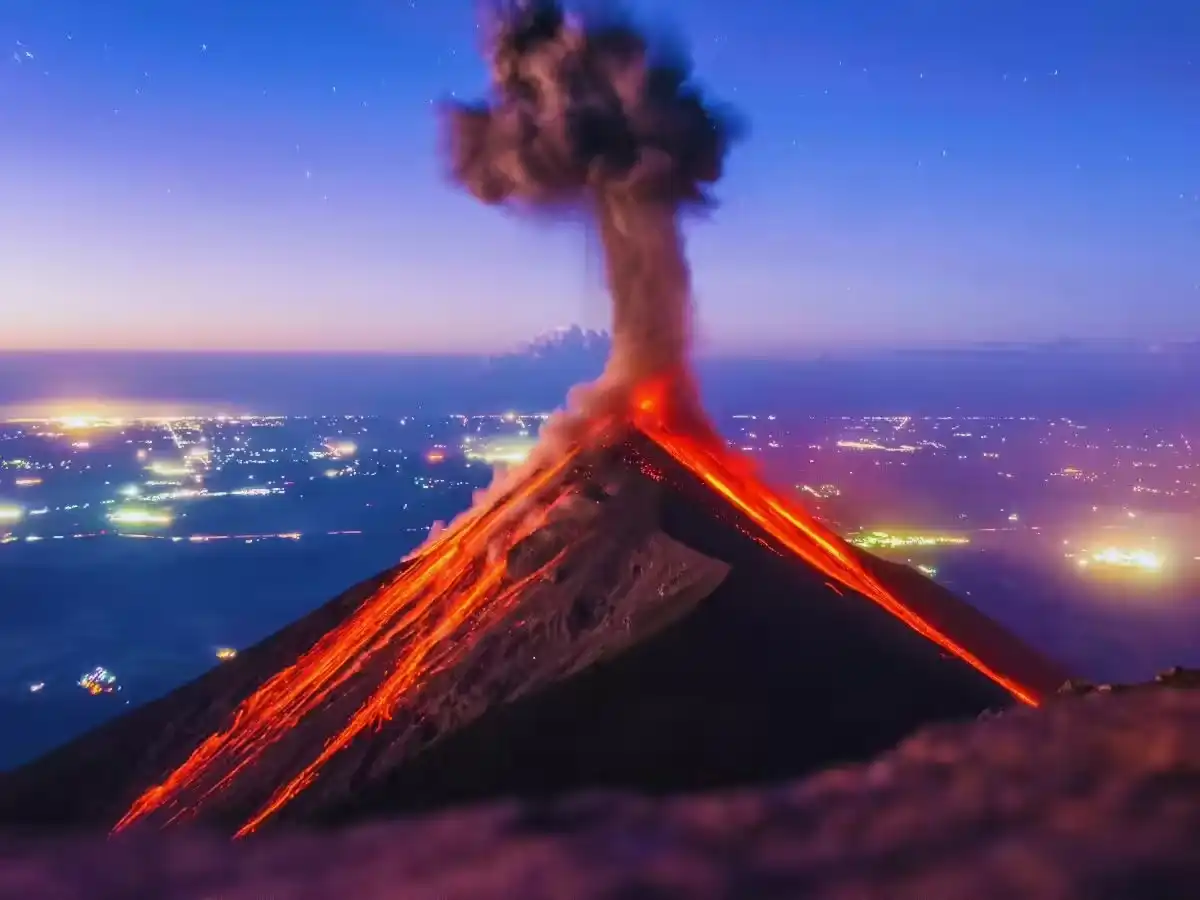
Under Antarctica’s miles-thick ice sheet, scientists have identified 207 possible volcanoes that may be speeding up ice melt and raising global sea levels, according to a recent study published in Earth-Science Reviews.
What’s happening?
Researchers created the first continent-wide inventory of these hidden volcanoes, called “ANT-SGV-25.” By mapping the volcanoes’ size, shape, and location, scientists hope to better understand how heat from beneath the Antarctic ice sheet threatens its stability.
Researchers from several universities compiled data from radar surveys, satellite imagery, and earlier volcanic records to document 207 subglacial volcanic structures. Many are clustered in West Antarctica.
Lead author Cui Xiangbin told Xinhua: “Recent research increasingly shows that subglacial volcanoes hidden beneath the massive ice sheet can alter subglacial topography, promote basal ice melting, regulate subglacial hydrological activity, and ultimately affect ice flow dynamics and the stability of the ice sheet.”
Why is Antarctic ice melt significant?
As Antarctica’s ice melts, global sea levels rise. When volcanoes heat the ice from below, meltwater forms and acts as a lubricant, which allows glaciers to slide faster toward the ocean.
Higher seas threaten coastal homes, roads, and drinking water supplies with flooding and saltwater contamination. According to Yale Environment 360, with 6 feet of sea-level rise, about 1.9 million U.S. homes (worth $882 billion) could be underwater by 2100.
The Federal Emergency Management Agency states that coastal flooding hazards such as storm surge, waves, and erosion “can cause extensive damage to homes, businesses, and infrastructure.”
Previous eruptions have changed the topography and posed a risk to communities. A 1996 eruption in Iceland triggered a sudden glacial flood, which, per a Smithsonian report, was preceded by “an unusual sequence” of earthquakes.
The report notes that extreme events like these have released gases that caused acid haze, which perturbed the weather in Western Eurasia, the North Atlantic, and the Arctic. Some of the impacts of this haze included “crop failures, livestock and fish deaths, and various illnesses, including fluorine poisoning.”
What’s being done about Antarctic ice melt?
By building this detailed volcano inventory, scientists can improve ice-sheet models and better predict sea-level rise. Continued satellite monitoring and international polar research help track changes in real time.
(Yahoo News)
The World Economic Forum has previously stated that, while some melting is now inevitable, humans “can still avoid the worst impacts by urgently cutting greenhouse gas emissions.”