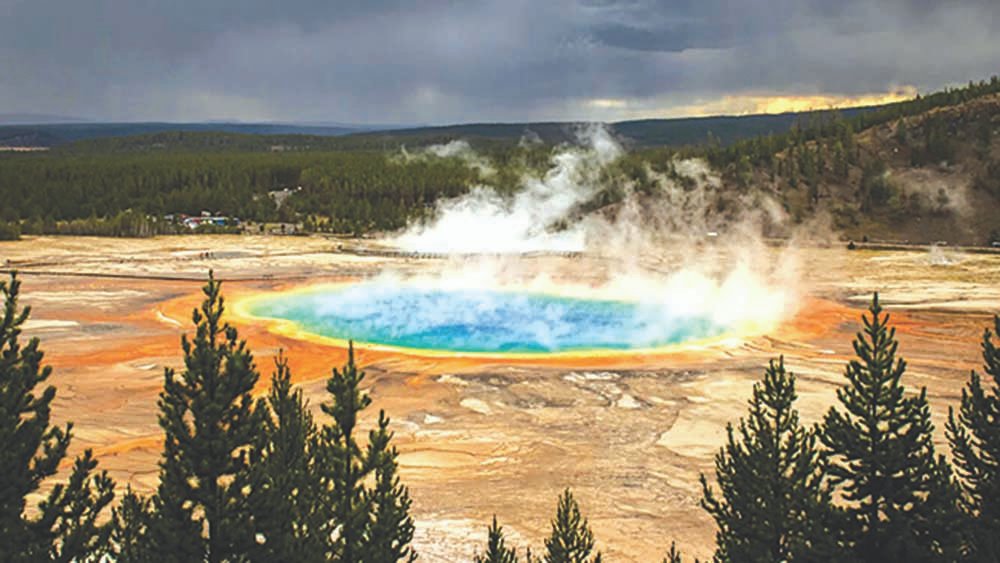
Scientists are sounding the alarm over new underground signals pointing to an unstoppable force building beneath the Earth’s surface. Recent data suggests a rare volcanic event could unfold sooner than anyone expected, with consequences that may ripple across the entire planet.
A recent Nature study, led by USGS researchers in collaboration with Oregon State University and the University of Wisconsin-Madison, used electromagnetic imaging to scan Yellowstone’s subsurface like never before. The technique, called magnetotellurics, captures shifts in the Earth’s natural electromagnetic field — usually triggered by lightning or solar storms — to detect how well rocks conduct electricity.
Since molten rock is more conductive than solid, the resulting image reveals where magma might be hiding. What they found were four distinct magma reservoirs, sitting between 4 and 11 kilometers beneath the caldera. These pockets, made of rhyolitic magma — rich in silica and prone to explosive eruptions — range in size and shape, but one in particular matches the volume expelled during Yellowstone’s Mesa Falls eruption, which occurred 1.3 million years ago.
The reservoirs aren’t entirely liquid — they’re more like thick mushes of crystal and melt — but their existence reshapes how geologists assess eruption risks in the region.
Until recently, most of the scientific focus had been on the central and western parts of the caldera. But new data now shifts the spotlight northeast, where a direct connection between shallow rhyolitic magma and deeper basaltic heat has been found.
This basaltic magma acts as the engine — supplying heat that could eventually melt more rock and link the reservoirs. According to the US Geological Survey, this connected system could “sustain and possibly grow the volume of magma in this region over hundreds of thousands of years.”
In contrast, the western side of the caldera appears to be cooling, with magma slowly solidifying and becoming less likely to erupt in the distant future.
Larry Mastin, a volcanologist at the USGS, notes in related research that “current melt fractions are too low to suggest imminent eruption,” but warns that connectivity and thermal evolution remain key variables. “Things can change in decades, not just millennia,” he told colleagues. (IDR)