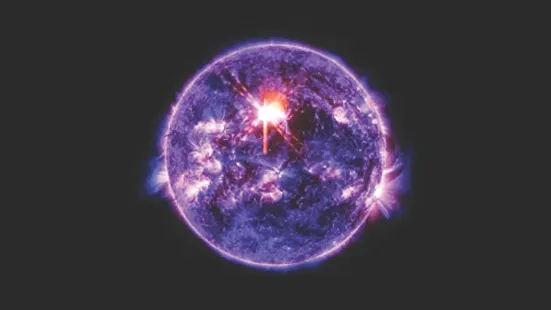
Scientists studying nearly 50 years of solar activity data say there is a heightened risk for extremely powerful solar eruptions known as “superflares” — events capable of disrupting satellites, power grids and communications systems, and potentially endangering astronauts.
The research, published in the Journal of Geophysical Research: Space Physics, proposes a forecasting system for “S-class” solar flares, defined as solar eruptions exceeding X10 intensity on the standard scale.
The biggest solar flare recorded so far in 2026 is a massive X8.3-class solar flare on Feb. 1.
The sun is currently waning from its “solar maximum” period — the peak of its roughly 11-year cycle when its magnetic activity intensifies. Scientists at NOAA and NASA estimate the solar maximum occurred in October 2024. Sporadic intense magnetic activity is often observed in the two years following solar maximum.
The study suggests the sun may be overdue for an “S-class” solar flare during the current Solar Cycle 25. Researchers analyzed data collected between 1975 and 2025 from the Geostationary Operational Environmental Satellites and identified 37 S-class superflares across previous solar cycles. According to the study, every solar cycle since the late 1970s has produced at least one Earth-directed superflare — except the current one.
The findings were published by an international team led by scientists at the National Autonomous University of Mexico.
Rather than attempting to predict the exact moment a flare will erupt, researchers developed a probabilistic system designed to identify time periods and regions on the sun where extreme flares are more likely to occur. The team discovered two recurring solar rhythms — cycles lasting roughly 1.7 years and seven years — linked to massive oscillations in the sun’s plasma (called magneto-Rossby waves). When both cycles align in a positive phase, the probability of an S-class flare increases sharply.
Using machine learning, the scientists identified two primary windows during Solar Cycle 25 when an S-flare is most likely — one spanning mid-2025 through mid-2026 and another forecast for early-to-mid 2027. The first period is associated primarily with the sun’s southern hemisphere, while the second shifts toward northern solar latitudes.
Major solar flares occur rapidly and unpredictably, making them difficult to forecast. This new method attempts to give space weather operators and satellite managers one to two years of advance warning of extreme events.
Although so-called superflares are rare, they do occur. During research for the study in May 2024, scientists detected several enormous flares erupting on the far side of the sun, hidden from Earth’s direct view. Among them were estimated X11.1 and X16.5-class eruptions — powerful enough to qualify as S-class superflares. Because the eruptions occurred on the sun’s far side, Earth avoided any impacts. May 2024 was a landmark month for space weather, seeing a G5-rated geomagnetic storm on May 10-11 — the strongest since 2003 — that caused global aurora. Space weather forecasters were unable to give a precise prediction in advance. The researchers say those events demonstrate that Solar Cycle 25 still contains enough magnetic energy to generate even stronger eruptions.
(Yahoo News)