
A state-level seminar and market linkage programme on spices, organised by the Spices Board India under the Ministry of Commerce and Industry, Government of India, was held on Wednesday at the Town Hall in Dimapur.
The programme brought together stakeholders, experts and industry representatives to deliberate on spice development and market access in Nagaland, highlighting both the sector’s vast potential and persistent challenges. Participants called for coordinated efforts to strengthen production, improve quality and build effective market linkages.
Speaking as the special guest, Razouvolie Dozo, Additional Secretary of the Department of Horticulture Nagaland, underscored the state’s natural advantage in spice cultivation. He noted that Nagaland’s diverse climatic conditions—from warmer lowlands to colder high-altitude regions—make it ideal for growing a wide variety of crops, particularly spices such as king chilli, cardamom and black pepper. Highlighting the uniqueness of local produce, he said the famed Naga King Chilli is known for its distinct aroma, pungency and high market value. While similar varieties are found in neighbouring states, he maintained that Nagaland’s produce remains superior in quality.
He also pointed out that the department has made significant investments in spice development, including area expansion, financial support to farmers and promotion through festivals such as the king chilli festival.
However, Dozo stressed that market linkage remains a major concern, citing a disconnect between buyers and producers.
“Farmers often ask where the market is, while buyers ask about production volume,” he said, urging farmers to scale up output and maintain premium organic quality. He also cautioned against premature harvesting, recalling instances where early sale of produce like kiwi led to poor market feedback and affected long-term prospects.
Deputy Director Dr. Cressida Jamir described market linkage in the state as “an illusion,” noting that despite years of discussions, a structured market system for agricultural produce is still lacking. She said that while production is not a major issue due to favourable soil and climate, key challenges remain in aggregation, grading, value addition and organised marketing.
Jamir emphasised the importance of Farmer Producer Organisations (FPOs), youth entrepreneurship and skill development, stating that empowering young people is crucial to transforming the agricultural economy. She also highlighted how middlemen often benefit due to lack of local processing and direct market access, urging local entrepreneurs to bridge this gap.
Chief general manager of mjunction services limited, Rituraj Hazarika, spoke on the company’s strategy for spice marketing in the Northeast. He highlighted the growing demand for Northeast spices in national and global markets, adding that major companies such as Tata Consumer Products Limited and ITC Limited are showing interest in sourcing from the region. He also announced plans to launch a dedicated digital platform to facilitate spice trade from the Northeast.
Hazarika further pointed out challenges such as inconsistent supply, poor packaging, lack of testing certifications and financial constraints faced by small farmers. He stressed the need for standardised quality, improved logistics and better access to finance to unlock the sector’s full potential.
The programme followed technical session wherein topic on “Turmeric-production and market insights” were shared by species board deputy director Dr Dwijendra Mohan Barman, “Naga king chilli-prospects and challenges” by spices board assistant director Vevotalu Rhakho and “Market potential and trends for ginger products” by spices board field officer Usham S Singh.
Earlier, welcome address was delivered by spices board deputy director (Dev) Dr Dwijendra Mohan Barman.
And later, the programme followed networking session which was carried out by Usham Sudheina Sing, Risuklin, Myliem, David and Jerimiah.
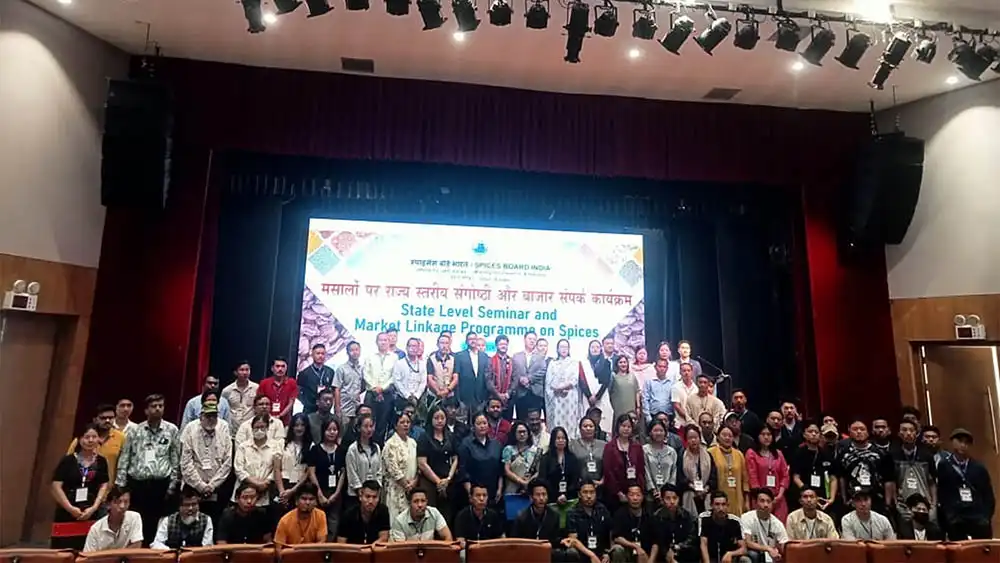
Seminar on spices, market linkages programme held
Staff ReporterDIMAPUR, MAR 25