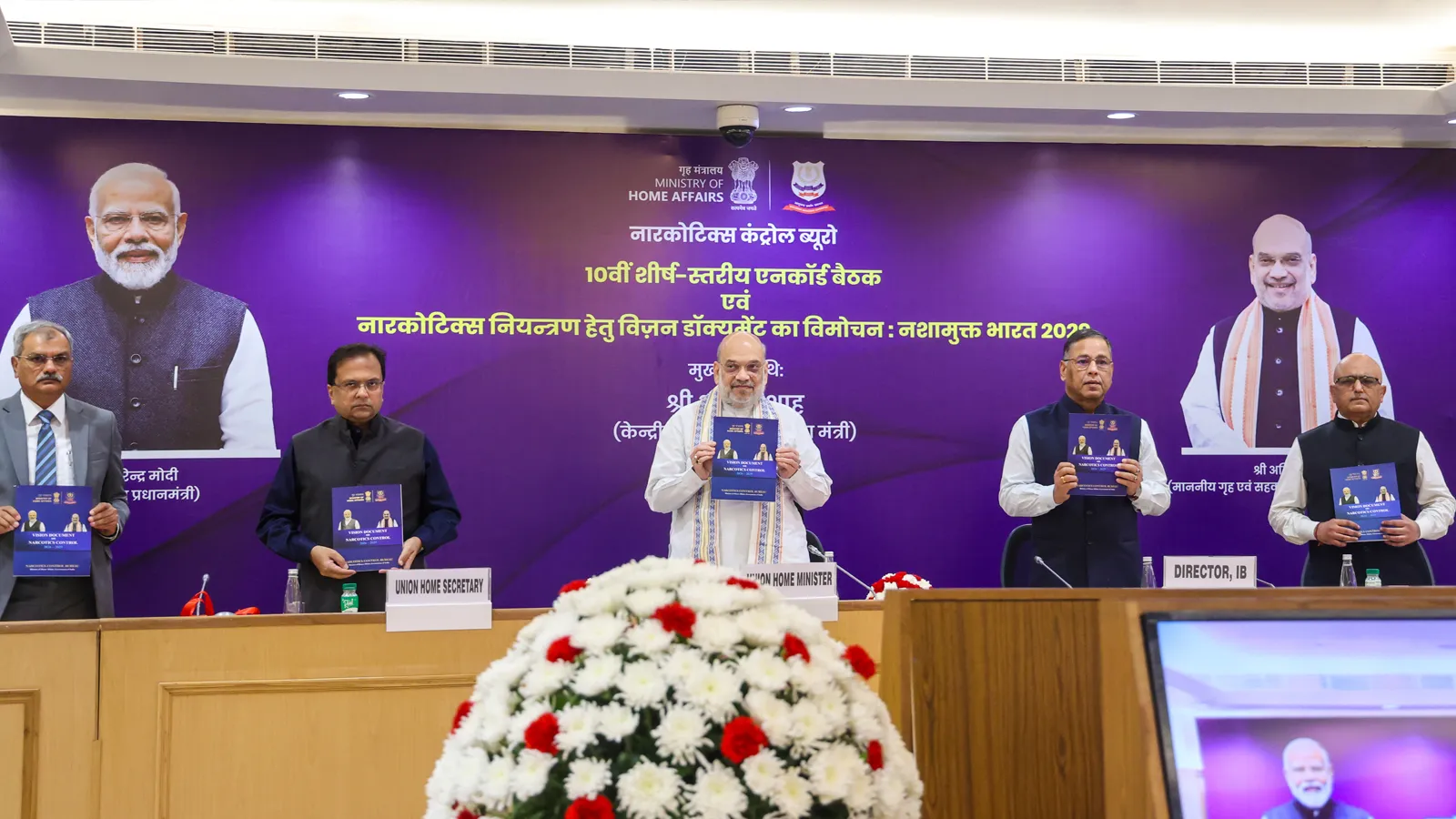
NEW DELHI, JUN 26 (PTI): Union Home Minister Amit Shah on Friday announced a new three-year roadmap aimed at dismantling drug trafficking networks through a “ruthless crackdown”, enforcement and financial investigations.
Chairing the 10th apex-level meeting of the Narco-Coordination Centre (NCORD), the home minister released the Vision Document on Drug Control (2026-2029), the Narcotics Control Bureau Annual Report-2025, and inaugurated the agency’s zonal offices in Jammu and Guwahati via videoconferencing.
He said the vision document outlines a strategy focused on strengthening institutional capacity against synthetic drugs, darknet-based trafficking, cross-border smuggling and other emerging threats.
“Under the leadership of Prime Minister Narendra Modi, we will strike the entire drug trade ecosystem so decisively over the next three years that it will not be able to recover for decades,” Shah said.
He told the anti-narcotics officers to adopt a policy of “detect, disrupt and destroy” to counter the menace of drug terrorism in the country.
He said, “We have to move forward to destroy all three types of cartels — those who bring drugs into the country, those who supply them from the borders to the states, and those who distribute them from states to the end users using human and technical intelligence.”
Shah said that under the detect, disrupt and destroy strategy, agencies must target the narcotics supply chain at the entry level.
Financial agencies will coordinate to monitor darknet activity, hawala networks, cryptocurrency transactions, and the use of ports and airports.
Under the strategy, enforcement agencies will target traffickers’ sources, transit routes, finances and leadership while intensifying action against illegal cultivation and clandestine drug laboratories.
Shah said financial investigations by the Enforcement Directorate (ED) under the anti-money laundering law will be strengthened to break drug networks and seize criminal assets.
Kingpins must not escape prosecution and the existing laws provide adequate powers, he said. He added that de-addiction and rehabilitation efforts would reduce the demand for drugs while law enforcement focuses on eliminating drug supply permanently.
Shah said India currently stands at a critical turning point in the fight against narcotics, where the next three years will decide “whether the drug trade will defeat us or we will defeat it”.
For the future of the country over the next 100 years, this battle must be won with firm determination and collective efforts, he said. “Our approach should be technology-driven and we must wage a network-centric war with a ruthless approach. Only then will we be able to secure victory against this problem,” he said.
The minister called for maintaining a ruthless approach towards those involved in drug trafficking and a sympathetic approach towards the victims of drugs.
He said compassion and goodwill can reconnect the victims with a normal life. They need to be guided back onto the right path.
This fight cannot be waged by any single department, state, government, or individual. Instead, all states and their concerned departments must come together on a single platform, he added.
Shah said the roadmap 2026-2029 prepared to achieve this goal is based on four major pillars: Enforcement, Intelligence and Operations; Precursors and Synthetic Drug Control; Demand and Harm Reduction; and Capacity Building, Coordination and Monitoring.
“Its aim is to conduct targeted intelligence-led action against the entire network and destroy it completely. We have to adopt a strategy to stop drugs at the production stage itself,” he said.
He said this roadmap has been prepared keeping in mind the “whole-of-government approach and the whole-of-society approach”.
Shah said the Centre was “relooking” at the Narcotic Drugs and Psychotropic Substances (NDPS) Act to plug loopholes exploited by narco syndicates.
He said the directors general of police can send their suggestions to the Ministry of Home Affairs and the chief secretaries can send theirs to the Department of Revenue under the Ministry of Finance.
The home minister also spoke about the success achieved by agencies in tackling the drug menace in the country.
“During 2004 to 2014, 26 lakh kilograms of synthetic drugs were seized. In contrast, from 2014 to 2026, we seized 1.18 crore kilograms of synthetic drugs. This shows that our campaign is steadily progressing towards success,” he said.
Shah said the value of the drugs seized between 2004 and 2014 was about Rs 40,000 crore, whereas the value of the drugs seized between 2014 and 2026 was about Rs 1.84 lakh crore.
This reflects the remarkable increase in the effectiveness and scope of the government’s actions, he said.
The minister asked state agencies to ensure real-time information sharing under all circumstances.
“For this, the Narcotics Control Bureau has developed several portals. I urge all chief secretaries and police chiefs to upload crime details for their respective states to these portals in a time-bound manner. This will enable the government of India to review these cases and provide you with necessary feedback and suggestions,” Shah said.
He urged all chief secretaries and police chiefs to move towards making NCORD meetings result-oriented.
“The number of meetings is certainly increasing, but it is also essential that they are result-oriented.
“Is effective implementation taking place of the decisions taken in the meetings? Are those decisions reviewed in the next meeting? Is there a rigorous and serious analysis of them? Efforts made at the state level in the direction of making meetings result-oriented alone can lead us to success,” he added.
The NCORD meeting brought together key stakeholders from 44 central ministries and departments, along with representatives from state governments and drug law enforcement agencies in hybrid mode.
The discussions focused on further strengthening the government’s efforts to achieve a drug-free India.
Challenges posed by synthetic drugs, darknet-enabled trafficking and expanding the reach of rehabilitation centres for drug users over the next three years were also discussed.