
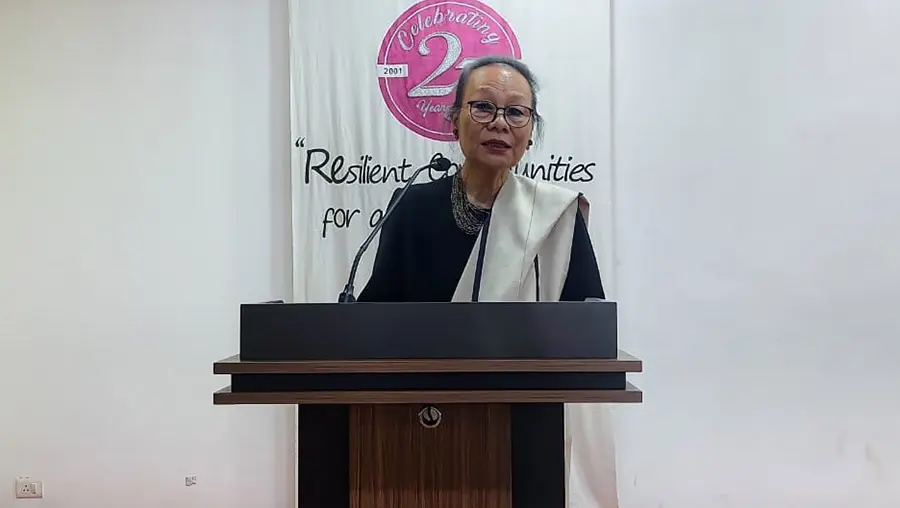
Sisterhood Network (SN) marked a significant milestone on May 5 as it celebrated its 25th anniversary at DBIDL, River Belt Colony, Don Bosco, Dimapur, under the theme “Resilient Communities for an Empowered Future.” The programme was graced by former chief secretary of Nagaland, Banuo Z. Jamir, as guest of honour.
Addressing the gathering, Banuo lauded the organisation for its sustained commitment to women’s empowerment and community development, describing the occasion as a “remarkable milestone” reflecting years of dedicated and impactful work. She noted that perceptions around women’s roles are gradually changing, with increasing recognition of their participation in planning and decision-making. Stressing that men and women are equal but different, she emphasised that empowerment should complement, not compete with men.
Recalling earlier challenges, Banuo said women’s empowerment was once “fraught with much frustration,” with gender often misunderstood.
However, she observed gradual progress, with more women entering senior positions. Highlighting gaps in representation, she cited male–female ratios in key services: IAS (78% male, 22% female), State Civil Service (71% male, 29% female), IPS (82% male, 18% female), Nagaland Police Service (84% male, 15% female), and the Legislative Assembly (97% male, 3% female).
She stressed that empowerment remains incomplete without women’s active involvement in decision-making, particularly in areas such as water management, where women play a central role.
Banuo praised SN’s initiatives including “Grassroots Voices”, which provides women a platform to express their views, and collaborations with women police personnel to combat gender-based violence. She urged that such efforts be expanded to other districts. She further emphasised education as a “great equalising platform,” livelihood diversification beyond agriculture, and preservation of cultural identity through weaving, song, dance and drama. Concluding her speech, she said Sisterhood Network, despite its size, serves as a “beacon of hope” for other organisations.
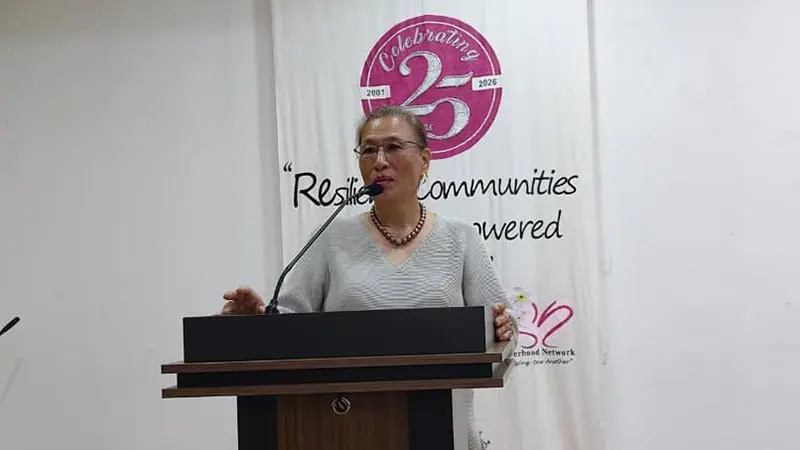
Founder Dr. Alongla P. Aier, Emeritus English Professor at Oriental Theological Seminary, expressed gratitude to supporters, partners and community members, stating that the organisation’s 25-year journey was made possible through collective effort and resilience. Recounting its origins in the turbulent 1990s, she said SN was born out of a growing need to support women and children affected by violence, displacement and disruption. With no formal plan or budget, the organisation began with “just a passion” and gradually expanded through surveys, self-help groups and skill development initiatives.
She noted that SN has since expanded its outreach to 19 villages across Dimapur, Chümoukedima, Niuland and Peren, supporting about 1,500 women through livelihood initiatives and 50 women’s collectives for financial stability. Over 600 children are enrolled in schools, with more than 500 receiving remedial educational support. The organisation also engages in campaigns on violence against women and child rights, including providing temporary shelter to women and girls in distress. Dr. Alongla highlighted resilience as a defining quality among women, adding that the organisation’s survival and growth were due to divine faithfulness and blessings.
Director Azungla James outlined the organisation’s future roadmap, stressing that its 25-year journey is “only the foundation” for greater work ahead.
Highlighting its alignment with the Sustainable Development Goals (SDGs), Azungla underscored its contributions in areas such as poverty reduction, education, gender equality, clean water and sanitation, and building sustainable communities. With the 2030 SDG deadline drawing closer, the organisation stressed the urgency of expanding its efforts, particularly by embracing climate action, given its disproportionate impact on women and children.
Azungla observed that SN is now receiving greater recognition and trust from government and community stakeholders, which brings increased responsibility to scale its work. She stressed the importance of nurturing women’s leadership, securing a permanent workspace, and continuing to support marginalised women in spaces often avoided by others. Despite challenges, she affirmed that Sisterhood Network will go ahead with confidence in its mission and vision.
The programme featured a traditional dance by Samziuram Women’s Group, a song by Eva Rongmei, short speeches by ActionAid regional director Mrinal Gohain, Gholu Women Group member Toliho Assumi, and Violence Reduction Unit coordinator Inotoli Zhimomi. A video message congratulating the organisation was also played. The event was chaired by SN administrator Arenzungla Jamir, with invocation by Nukshila Aying Doulo, vote of thanks by director Azungla James, and prayer by Rev. Dr. Joshua Lorin.