
The State government on Tuesday proposed that a 15-metre Right of Way (RoW) be provided free of cost for the proposed Trans-Nagaland Highway (Foothill Road) and directed that it be finalised within 15 days through consultations with all affected villages under their respective District Planning and Development Boards (DPDBs).
The proposal was made by deputy chief minister T.R. Zeliang during a high-level meeting held at Capital Convention Centre, Kohima.
The meeting also deliberated on upgradation and construction of the Trans-Nagaland Highway to National Highway (NH) standards and the implications of adopting the National Highways Act, 1956 in the State. The meeting was attended by representatives of 16 tribal bodies, members from Chakhroma Public Organisation and Western Sumi Hoho, elected representatives from affected districts, all deputy commissioners and officials from Nagaland Public Works Department (NPWD).
The house was informed that the Ministry of Road Transport and Highways (MoRTH) had conveyed its willingness to declare the road as a National Highway and undertake its construction, subject to the condition that the State provides a 30-metre RoW free of cost.
However, upon deliberation, the majority view of the house was that providing a 30-metre RoW free of cost was not feasible under the prevailing circumstances. It was pointed out that at present only 12 metres of RoW was being provided free of cost for the ongoing intermediate lane Foothill Road.
As a way forward, Zeliang proposed that a 15-metre RoW be provided free of cost and directed that it be finalised within 15 days through consultations with all affected villages under their respective District Planning and Development Boards (DPDBs). He further stated that upon receipt of written consent from all affected Foothill Road districts, the proposal would be taken up with the Ministry for necessary action.
Earlier, in his opening remarks, Zeliang clarified that the purpose of the meeting was not to review or deliberate on the ongoing Foothill Road project, but to explore modalities for upgrading and constructing the road to NH standards under MoRTH, considering its immense economic and social significance.
He informed that the Ministry had expressed willingness to undertake the construction and subsequent maintenance of the road in line with other National Highways across the country.
During the meeting, extensive discussions were held on both the Foothill Road project and provisions of the NH Act, 1956, particularly land acquisition and compensation.
It was observed that earlier State policies had created constraints in securing land compensation for NH projects between 2018 and 2023. The State Cabinet in November 2023 had resolved to permit land compensation for NH projects; however, the matter remained unresolved with the Ministry due to concerns regarding applicability of the NH Act in the context of Article 371(A).
With regard to adoption of the NH Act, 1956, as insisted upon by the Ministry, the house reached a broad consensus that the Act should not be adopted if it infringes upon the provisions of Article 371(A). While acknowledging that the NH Act offers comparatively greater benefits than the existing State Act of 1965, concerns were raised over certain provisions that may contravene the constitutional safeguards, leading to apprehensions among stakeholders.
In addition to representatives of tribal bodies, several elected members, including C.L. John, Nuklutoshi, Achumbemo Kikon, Zhaleo Rio and Namri Nchang, shared their views and unanimously appealed to citizens to consider parting with land, as required by the Ministry, in order to enable the State to secure durable, high-quality road infrastructure for future generations.
During the deliberations, minister G. Kaito Aye emphasised that for the ongoing Foothill Road works, tribal bodies must continue to extend full cooperation to ensure timely completion without hindrance and stressed that where competent technical authorities were in place, other public organisations should refrain from overstepping their mandate or interfering in departmental functions.
Responding to queries raised by certain tribal bodies regarding construction of NH-202, though not part of the formal agenda, Zeliang clarified that delay in securing sanction for the project was directly linked to the pending policy decision on adoption of the NH Act, 1956. He further noted that additional delays had arisen due to certain technical issues in appointment of a DPR consultant, while assuring that the matter was being actively pursued and expressed optimism that the issues would be resolved at the earliest.
In his concluding remarks, Zeliang expressed appreciation to all elected members, tribal bodies and deputy commissioners for their participation and valuable contributions. He underscored the importance of initiating immediate grassroots-level consultations and urged tribal bodies to engage with all stakeholders, including village councils, on the issue of land contribution.
The meeting concluded with a collective resolve to continue consultations and arrive at a mutually acceptable solution in the larger interest of the State’s development and connectivity.
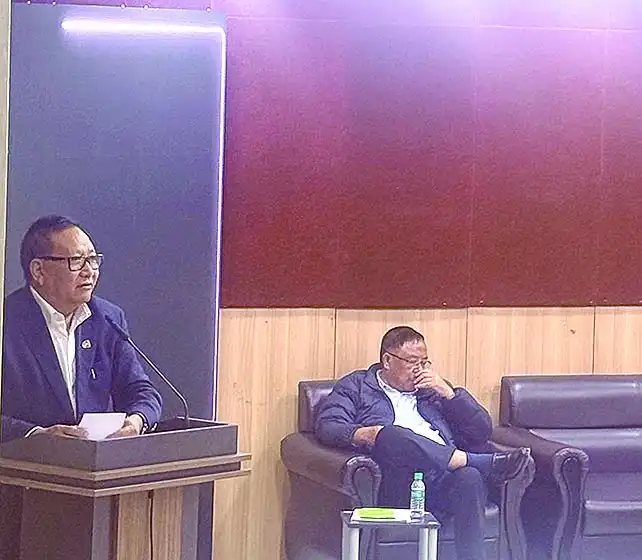
State govt proposes 15m RoW for Foothill road
DIMAPUR, APR 7 (NPN):