
Staff Reporter
DIMAPUR, NOV 13 (NPN): Nagaland lost 795 square kilometres of forest cover between 2013 and 2023, accounting for around five percent of the state’s total geographical area.
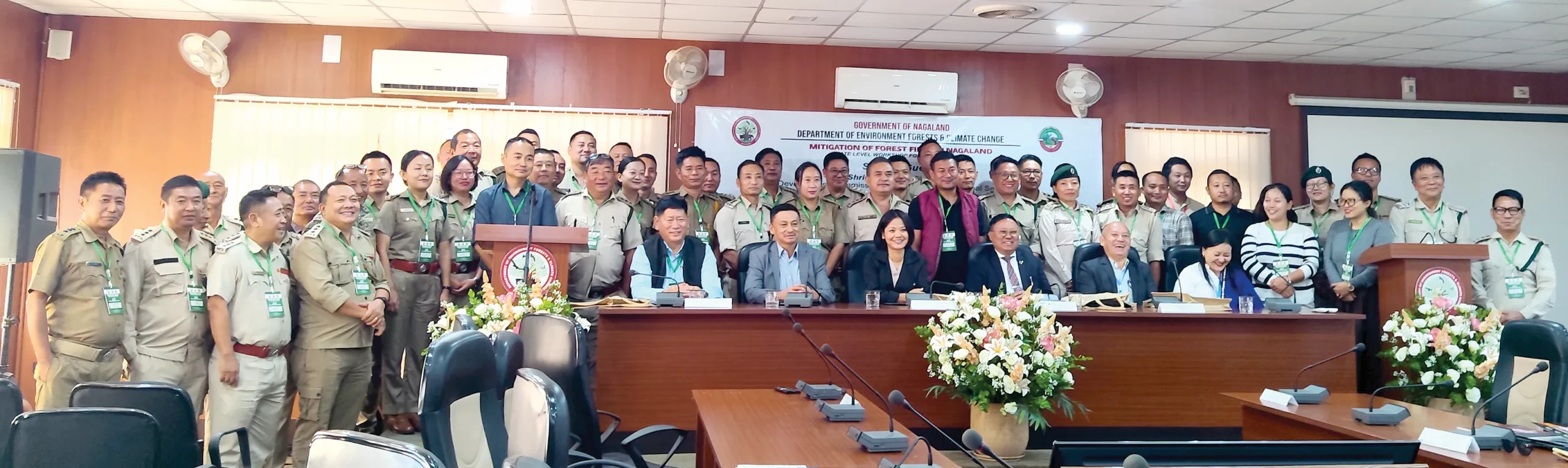
This was disclosed by development commissioner and principal secretary, Department of Environment, Forests and Climate Change (EF&CC), Y Kikheto Sema on Friday. He was addressing the inaugural programme of a two-day workshop on “Mitigation of Forest Fires in Nagaland”, organised by the State Environment and Forestry Training Institute (SEFTI) at the Forest Office Complex Conference Hall.
He stressed that forest conservation and fire prevention required a proactive, community-centric approach, as the responsibility could not rest with the forest department alone.
Expressing concern over the decline in forest cover, Kikheto urged forest officers and field staff to take responsibility for creating awareness and promoting tree plantation in their respective jurisdictions.
He pointed out that Nagaland’s land ownership pattern, protected under Article 371A of the Constitution, made forest conservation a collective responsibility. The government and forest department owned less than 5% of state’s total land and forest area, he said, adding that the department could not independently tackle forest fires, biodiversity loss and wildlife protection without active community participation.
Kikheto said people needed to be made aware of their role as custodians of nature and encouraged to use forests and biodiversity sustainably rather than destroy them.
Identifying jhum and shifting cultivation as major causes of forest fires, he acknowledged that traditional practices could not simply be stopped because of their deep connection with the state’s culture, songs and festivals. However, he stressed the need for systematic and controlled cultivation practices to prevent fires from spreading and damaging forests.
He said forest fires affected not only the environment and biodiversity but also caused soil degradation, disrupted water conservation, contributed to climate change and threatened food security and livelihoods, with long-term economic consequences.
Kikheto also identified hunting and the collection of forest products as areas requiring greater awareness and monitoring. He called upon forest officers to work closely with village councils, VDBs, youth organisations and women’s organisations to sensitise communities.
Stressing that prevention should be the first priority, he called for mapping fire-prone areas and strengthening early warning, monitoring and rapid response mechanisms. He suggested greater use of satellite-based forest fire alerts from the Forest Survey of India, along with the state’s Geographic Information System and Remote Sensing facilities.
He also stressed coordination with district administrations, the science and technology department, disaster management authorities and fire and emergency services. Forest fire management, he said, must shift from reactive firefighting to prevention, combining traditional knowledge with modern technology and focusing on forest resilience, biodiversity and sustainable livelihoods.
On wildlife conservation, Kikheto said awareness of the Wildlife Protection Act remained inadequate despite decades of implementation in the state. He said he had directed the principal chief conservator of forests (PCCF) and senior officers to publish wildlife protection guidelines in all Naga languages and distribute them across Nagaland.
Highlighting commercial plantation as a source of employment, he identified agarwood, sandalwood, coffee, tea and rubber as promising sectors for unemployed youth. He said the state government had approved the Agarwood Policy and identified the sector as a priority under Vision Nagaland 2047. Farmers had faced marketing difficulties due to the absence of a proper policy and rules, he added.
Citing a recent assessment by research scientists, Kikheto said red sanders was unsuitable for commercial cultivation in Nagaland and the Northeast due to limited market potential. White sandalwood, however, showed promise, with its quality reportedly comparable to Karnataka’s, though slightly lower. He said the PCCF office had been asked to submit a concept proposal for sandalwood cultivation to enable the state to consider a separate policy.
He also said Nagaland coffee had attracted demand from South Africa, Japan, Dubai and Korea, and urged young people to explore commercial plantations and other agricultural and horticultural opportunities rather than depend solely on government employment.
Kikheto called for forest officers and geoscientists to be involved in road surveys and preparation of DPRs to ensure environmental concerns were considered in infrastructure development.
He also proposed a large-scale tree plantation drive next year, saying he had discussed the initiative with forest minister CL John. The drive, he said, should be undertaken on a war footing with community participation to protect forests for future generations.
Earlier, delivering the keynote address, conservator of forests (RPU) Lhinghoikim Touthang said prevention remained the most effective way to tackle forest fires.
“The best way to fight a forest fire is to not start one,” she said, adding that containment could not undo the damage to lives, property, biodiversity and infrastructure once a fire spread.
Recounting her experience of the Dzükou fire during her probation in 2014-15, Touthang said dry winter conditions and bamboo grass had contributed to its rapid spread.
She said the incident underscored the need for community participation and interdepartmental coordination. Touthang called for accurate vulnerability mapping, early warning systems, fire lines, appropriate equipment and public awareness to minimise damage.
She urged participants to engage in the technical sessions and interact with experts to strengthen their understanding of forest fire prevention and mitigation.
The programme was chaired by SEFTI assistant director, Imtitongdang Ozukum. SEFTI director, delivered the welcome address, while DFO Dimapur Beizo Suokhrie proposed the vote of thanks.
The invocation was offered by KBBD associate pastor youth Yongna Y. Konyak, while Impochang Pongen presented a special song.
The two- day workshop brought together forest officers and field personnel to deliberate on strategies and measures for mitigating forest fires in Nagaland.