NEW DELHI, JUL 14 (PTI): The Jal Shakti Ministry on Tuesday urged states and districts to accelerate the certification of Har Ghar Jal gram panchayats and complete the digital mapping and geo-tagging of all rural water supply assets to strengthen monitoring and service delivery under Jal Jeevan Mission (JJM) 2.0.
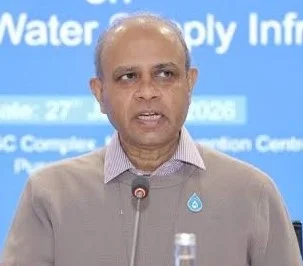
The directions were issued by Department of Drinking Water and Sanitation (DDWS) Secretary Ashok K K Meena while chairing the 10th District Collectors’ Peyjal Samvad through video conferencing to review the implementation of JJM 2.0.
According to an official statement, Meena also directed states and districts to institutionalise Jal Arpan as an annual community-led event in every gram panchayat to reinforce community ownership of rural water supply systems.
He said more than 1.17 lakh activities have already been carried out across the country under the Jal Seva Aankalan initiative.
The secretary directed officials to digitally map all rural water supply assets, from source to tap, through the Sujalam Bharat Digital Registry integrated with the PM Gati Shakti portal, and ensure geo-tagging of all assets to enable better monitoring, preventive maintenance and evidence-based decision-making.
Additional Secretary and National Jal Jeevan Mission Director Kamal Kishore Soan said sustained service delivery, source sustainability, community participation and technology-driven monitoring will be the key pillars of JJM 2.0.
He urged district administrations to strengthen inter-departmental convergence, regularly review implementation and ensure proper mapping of Har Ghar Jal assets.
The meeting also showcased best practices from five districts.
Kinnaur in Himachal Pradesh reported achieving 100 per cent Har Ghar Jal coverage across all its 210 villages despite difficult mountainous terrain, scattered habitations and extreme weather conditions.
Haveri in Karnataka said it has achieved 95.36 per cent Functional Household Tap Connection (FHTC) coverage and is implementing large multi-village schemes under the Design-Build-Operate-Transfer model. It also highlighted geo-tagging of water supply assets, a mobile application for water quality monitoring and six villages with round-the-clock water supply.
Dumka in Jharkhand presented its convergence-based model for restoring and sustaining rural drinking water infrastructure through an integrated control room, trained village-level maintenance personnel, local spare-part supply chains and strengthened grievance redressal.
South Goa said all 118 Jal Jeevan Mission works have been completed and commissioned, providing tap water connectivity to all rural households, while nearly 96 per cent of the state’s drinking water demand is being met through surface water-based regional water supply systems.
Unakoti in Tripura reported 89.16 per cent FHTC coverage benefiting more than 47,800 households and highlighted regular district-level monitoring, third-party inspections, digital grievance redressal and community participation.