
DIMAPUR,SEP 18 (NPN): Department of Political Science and History, Dimapur Government College (DGC), in collaboration with the PA Sangma Foundation, organised “The PA Sangma Dialogues” under the theme “Peace through Development: Nagaland and the Unified Journey of the Northeast” at the college auditorium on Friday.
Delivering Dialogue 1, author, poet and public policy analyst Mmhonlümo Kikon spoke on “A Region in the Union: Federalism, Autonomy, and Naga Identity.” He emphasised the importance of informed public discourse on policies and constitutional provisions with long term implications for Nagaland.
Kikon noted that society often held contradictory expectations of political leaders-demanding they be well informed on policy issues, yet dismissed those who demonstrated such knowledge as more suited to academia. He said this reflected a broader confusion about the role of policymakers and the way politics and public policy are discussed.
Urging students to take greater interest in policy documents and current affairs, Kikon pointed out that decisions affecting future generations could not be meaningfully debated without informed understanding. Referring to the recently passed Frontier Nagaland Territorial Authority (FNTA) Act, he expressed disappointment that few students had read the legislation despite its long term significance for the State.
On a student’s query regarding the difference between FNTA and the Sixth Schedule provisions applicable in Assam, Meghalaya, Mizoram and Tripura, Kikon explained that the Sixth Schedule had historical roots in colonial era policies aimed at safeguarding hill tribal communities.
He said it provided constitutional protection and enabled autonomous district councils to exercise powers relating to customary practices, administration, land and resources, taxation and local governance.
He noted that the application of the Sixth Schedule varied across States due to distinct demographic and political circumstances, citing examples from Meghalaya, Assam, Mizoram and Tripura.
He described the broader constitutional arrangement in the Northeast as “asymmetrical federalism,” where different States and communities maintain distinct relationships with the Union based on historical circumstances and aspirations.
Kikon further highlighted provisions such as Articles 371A and 371G, which recognise India’s diversity by providing safeguards for specific social, religious and customary practices. Drawing a distinction, he said Article 371A is a constitutional safeguard concerning land and resources, while FNTA is the outcome of a political agreement involving the Ministry of Home Affairs, Government of Nagaland, and the Eastern Nagaland Peoples’ Organisation (ENPO).
He stressed that the constitutional character of Article 371A and the political character of FNTA represented different mechanisms for addressing community aspirations.
Responding to questions on legislative powers, Kikon urged students to examine how customary institutions address contemporary issues of justice, particularly those concerning women.
He cautioned that traditional approaches should not become obstacles to justice, citing instances where social considerations discouraged victims from pursuing cases.
He said the challenge for the younger generation was to consider how traditional institutions and constitutional principles could respond effectively to present realities.
He further noted that urbanisation was changing approaches to justice, with more people in urban centres increasingly turning to regular courts for certain disputes. Earlier, the programme was chaired by Associate Professor, DGC, A. Moamongla Aier, with the welcome address delivered by Vice Principal, N. Sentinungla Pongen. A special song was presented by the Political Science Club, DGC.
The second session featured a dialogue on “The Kitchen and the Loom: Food, Culture and the Politics of Diversity,” with food writer and digital chronicler of traditional weaves from the Northeast, Avantika Roohi, as the resource person.
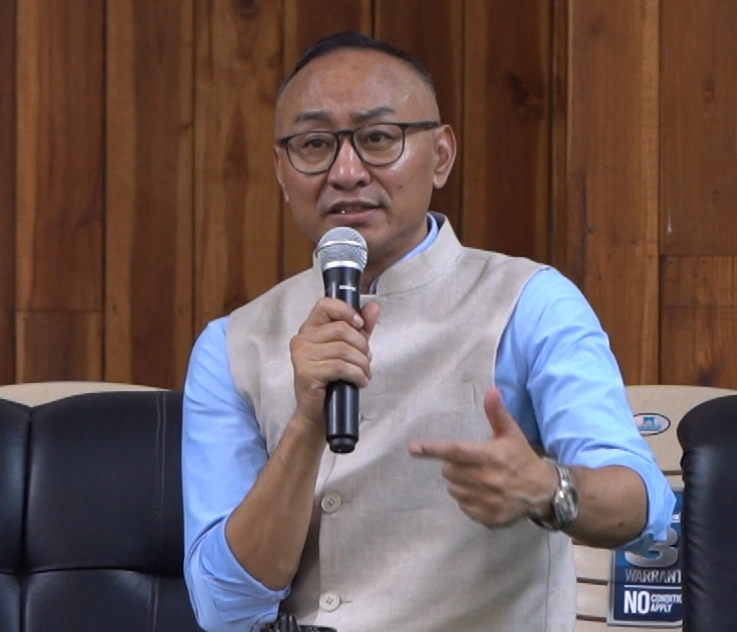
Students urged to engage in policy discourse at ‘PA Sangma Dialogues’
Staff Reporter