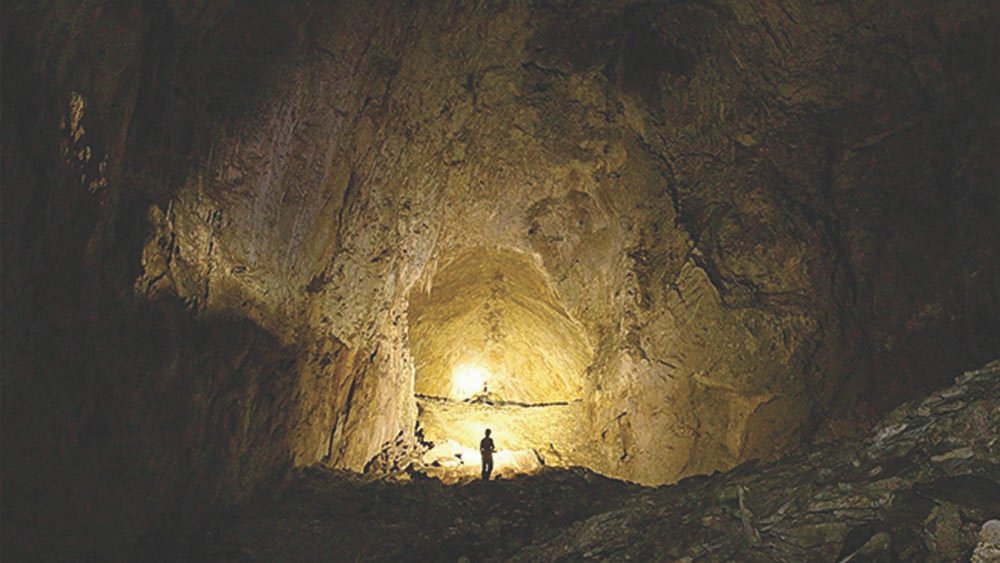
When cave biologist Hazel Barton ventured into the pitch darkness, the last thing she expected to find were organisms harnessing energy from light. This new understanding of photosynthesis in the dark, she realised, means life elsewhere in the Universe could exist in places we never thought possible.
“The wall was bright green. It was the most iridescent green you’d ever seen, and yet the microbes were living in complete darkness,” says Barton, professor of geological sciences at the University of Alabama.
Beneath the deep rocky canyons of the Chihuahuan Desert in southern New Mexico, lies a network of 119 caves. The caves, part of the Carlsbad Caverns National Park, formed four to 11 million years ago due to sulphuric acid dissolving the limestone rocks.
The primary attraction of the park is the show cave, Carlsbad Cavern. Here, glittering stalactites cling to the roof of the Big Room, a huge underground chamber measuring almost 4,000ft (1,220m) long and 625ft (191m) wide.
“The Carlsbad cavern is very easily accessible. It’s a very large limestone cave that tourists can visit that has steps and ladders and everyone can go down,” says Lars Behrendt, a microbial biologist at Uppsala University. Parts of the cave system, he adds, are even wheelchair accessible.
Almost 350,000 people visit Carlsbad cavern each year, yet most would be completely unaware that the cave is the setting to one of the most baffling scientific discoveries of the past decade.
In 2018, Behrendt had just finished his PhD. He had also won an academic prize, which awarded him some money. He contacted Barton and asked her if she would accompany him on an expedition. Luckily, she agreed.
“The first thing you do in the Carlsbad cave is you kind of go down on the tourist trail, and then you turn around a corner,” says Barton. “I don’t know how many times I’ve done that trail, probably 40 times. At that point, you go around the corner, and then behind you there’s an alcove, and it’s completely black.”
For more than 20 years, Barton has been studying microscopic life found deep underground. Yet what happened next was a surprise, even to her.
Behrendt shone a torch on the wall. Although the alcove was pitch black, the light revealed a blanket of green microbes clinging to the wall. Later tests revealed they were cyanobacteria; single celled organisms related to bacteria. Unlike most bacteria, though, cyanobacteria (also known as blue-green algae) use light from the Sun to make food.
“We started going deeper and deeper into the cave,” says Barton. “Eventually we were a point where we couldn’t see without using flashlights. We had to use a headlight to be able to see our hand in front of our face, and yet you could still see green pigment on the wall.”
Plants are green due to a chemical called chlorophyll, which absorbs light energy. In photosynthesis, this energy is used to convert carbon dioxide and water into glucose and oxygen. The process is much the same in cyanobacteria. Yet here, in the cave, there was no sunlight.
It turns out that the cyanobacteria in the cave have a special version of chlorophyll that can capture near-infrared light. This light has a longer wavelength than visible light, and appears just before infrared on the electromagnetic spectrum. It is undetectable to the human eye.
While plants and cyanobacteria use chlorophyll a for photosynthesis, the cyanobacteria in the Carlsbad caves use chlorophyll d and f, which are able to generate energy from near-infrared light.
Although visible light can only travel a few hundred feet into the caves, near-infrared can journey a lot further due to the reflective nature of the limestone rocks. “The limestone rock that the cave is made of will absorb almost all visible light, but to near-infrared light, caves are pretty much a hall of mirrors,” says Barton.
In fact, when the researchers measured the light in the back of the cave where it was darkest, they found the levels of near-infrared light were 695 times more concentrated than at the entrance. At the same time, while chlorophyll d and f containing cyanobacteria were present in all parts of the cave, they were particularly concentrated in the darkest and deepest places.
The researchers also hiked out to other caves in the Carlsbad Caverns National Park and tested other off-the-beaten-track caves and caverns. In each case they found photosynthesising microbes deep down underground.
“We showed that not only do they live down there, but that they photosynthesise in a completely sheltered environment where they’ve probably been untouched for 49 million years,” says Behrendt. (BBC)