
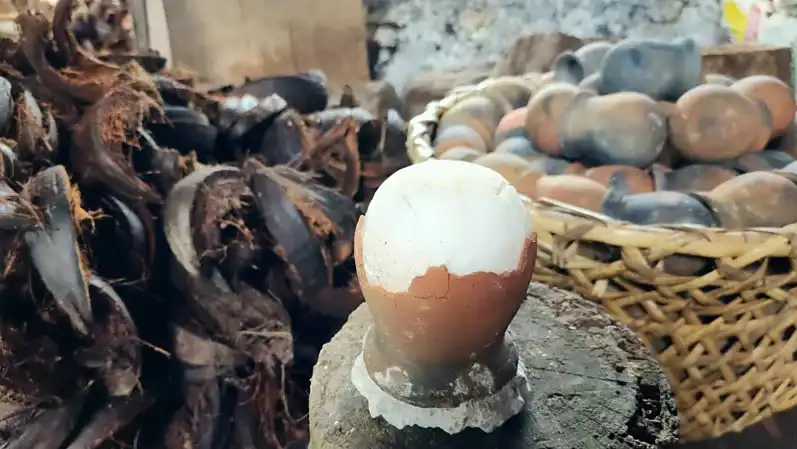
In a thatched-roof workshop on the Filipino island of Bohol, 68-year-old Romano Apatay uses a scoop made from an empty shell to pour brine into a series of brown, orb-shaped clay pots suspended over a wood fire. When the pots begin to crack, he removes them from the flames. Once cooled, he turns them over and carefully breaks open their brittle outer shell with his fingertips, revealing a white sphere that’s one of the rarest salts on Earth.
This is asin tibuok, which means “unbroken salt”, but it’s popularly known as “dinosaur egg” salt, thanks to its ovoid appearance. Once ubiquitous throughout the island, asin tibuok production has declined drastically in recent years. Apatay is one of the few people on Bohol still making it – and is part of a new generation helping to save it from extinction.
A centuries-old tradition
Asin tibuok has been made on Bohol since at least the 1600s. It was first recorded in the 17th Century by a Spanish missionary who described the local practice of filtering seawater through the ashes of charred coconut husks and baking brine inside clay orbs.
Yet, ethnoarchaeologist Andrea Yankowski says this indigenous Filipino craft existed long before the arrival of the Spanish. Yankowski first came across asin tibuok 20 years ago when she was carrying out research on the island. In 2019 she realised there were only a few manganisays (salt makers) left and she started to record their work.
“Many communities along the southern coast of the island participated in salt making,” she says. “This salt was regularly traded to the island’s interior, where there are farmlands, for rice and other agricultural products. [It] was also traded to other islands.”
For generations, asin tibuok was produced by families living along the coastline who would tie a piece of string to the egg-shaped salt and dip the orb into savoury rice porridge. But in recent years, as mangasinays have aged and successors were unwilling to carry on the labour-intensive craft, the practice has nearly disappeared. Until a few decades ago, an estimated 100 families produced it. “It is very important for me to save a craft that could die out,” says Apatay. “I am proud of the legacy of my forefathers.”
A return from extinction
In recent years, this centuries-old tradition has experienced something of a revival, thanks to TikTokers and Gen Z chefs who have started falling for the smoky-tasting mineral. In 2021, Filipino YouTube star Erwan Heussaff shared a video of the salt being made to his millions of followers. Then in 2023, dinosaur eggs starred in an episode of Filipino Netflix drama Replacing Chef Chico. And in December 2025, asin tibuok was recognised by Unesco as an Intangible Cultural Heritage in Need of Urgent Safeguarding. (BBC)
In 1995, the Philippine government passed a law stipulating that salt must be iodised. As a result, fewer families continued producing it and asin tibuok production began its steep decline. But as awareness of dinosaur eggs’ cultural importance grew, the ruling was lifted in March 2024.