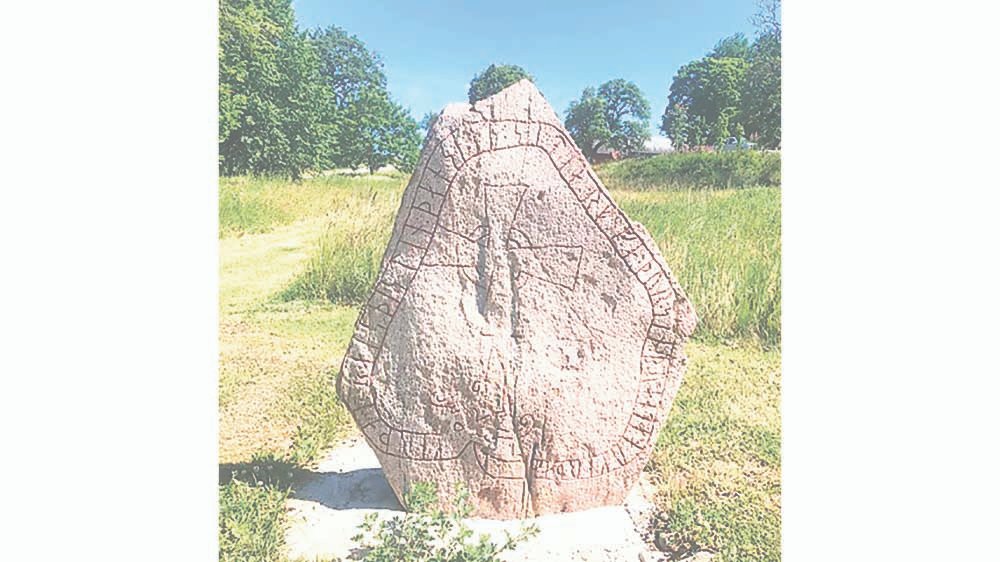
Runic inscriptions from the Viking Age still turn up in Sweden 1,000 years after they were written – revealing fascinating stories of love, loss and epic battles.
A few years ago, Magnus Källström, a Swedish rune expert, travelled to a farm a few hours south of Stockholm to look at a stone covered in ancient runic writing. A farmer had found the stone in a field and had planned to use it as a doorstep until he turned it over and saw rows of ancient, twig-like signs: runes, used by Vikings around 1,000 years ago.
When Källström arrived, the residents at the farm and local archaeologists gathered around him as he stumbled at the first word, then read the text out loud. Word by word, he was voicing a message no-one had read or heard in almost a millennium: “Gärder erected this stone in memory of Sigdjärv his father, Ögärd’s husband.”
As surprising as this discovery may sound, it’s not uncommon for ancient rune stones to turn up by chance in modern-day Sweden and other Scandinavian countries. They emerge as people build bike lanes or plough their fields. Some are extremely old and date to the earliest days of this mysterious script, such as an up to 2,000-year-old rune stone discovered in Norway in 2023. Over their lifetime, some simply ended up as raw material for construction, smashed to pieces to provide a house foundation or accidentally covered in granite under a church doorstep.
For ordinary Swedes like me, the stones are also a familiar part of the scenery. They appear in fields and meadows, in the middle of roundabouts and in industrial parks. Specific signs point to heritage sites near roads, often containing runes – signs that I, once a child stuck in the backseat of the family car on holidays, still associate with boredom. And yet, despite this familiarity, the stones and the enigmatic writing on them still hold many surprises and unsolved puzzles.
The word “rune” stems from the Old Norse word rún, which means secret. Runic writing, a script that has many variations but usually consists of 24 or, later, 16 letters, was first used in northern Europe some 2,000 years ago. It was invented, researchers believe, when merchants and travellers from northern Europe came across scripts such as the Latin alphabet on their trips to southern Europe. They then used those scripts to come up with their own form of writing, capturing northern European languages such as Old Norse.
Runes were written on a range of materials, including wood, bone and stone, and even on ordinary tools. “Do you think of me, I think of you, do you love me, I love you”, says a message on a textile tool from the end of the 11th Century, found outside Gothenburg. Stone texts, however, are the most durable and visible form. Runic writing can even be found on cliffs, though most commonly, it appears on rune stones: inscribed stone slabs that are often human-height or taller; rune stones.
Rune stones were put up as “memorial stones, often erected where people pass by, roads and fords and council places and such, visible and public”, says Källström, the foremost expert of runes of the Swedish National Heritage Board. The stones became popular in Scandinavia from around 300 AD, but their golden age is associated with Viking times, between the years 800-1050 AD. In fact, the stones have even been described as the social media of the Viking Age.
However, commissioning a stone wouldn’t have been cheap, Källström explains, and often, a professional carver was employed. “You can suspect that it wasn’t for just anybody,” he says. They were popular during the time missionaries brought Christianity to Sweden, Källström says, and the scripts often included references to the new faith, such as calls for prayers to be read for the dead, alongside decorations of crosses.
But runes were used more informally, too, for jokes, riddles and puns, according to Källström. He gives the example of animal bones carved with runes for training. When read from one direction and then turned 180 degrees for the rest of the text, they spell out messages like: “ráð þat” (decipher this), or, “l gott”, (tasty beer).
“So that’s a form of Viking party trick, like: ‘What does this say?’,” he says of the riddle bones. “That’s one of my favourites.” (BBC)