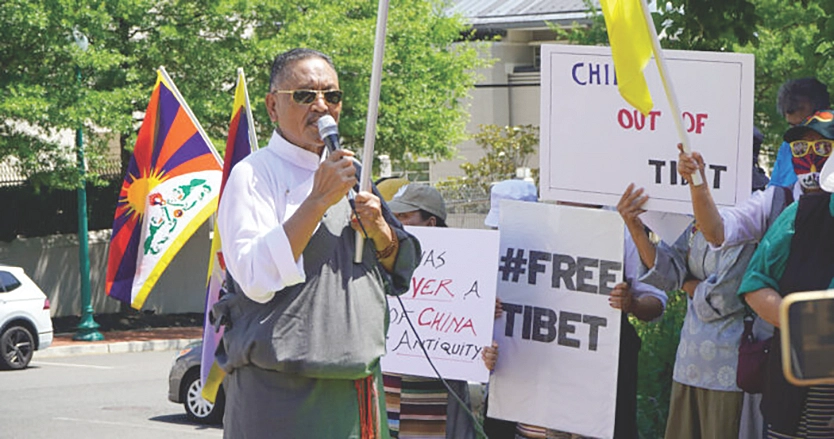
WASHINGTON, JUL 20 (IANS): The International Campaign for Tibet (ICT) has urged the US Congress to pass legislation strengthening Washington’s engagement with Tibet’s elected leadership and called on the Trump administration to condemn China’s new ethnic unity law.
The appeal came as the United States observed Captive Nations Week from July 19 to 25. The group said the occasion should be used to reaffirm bipartisan American support for the Tibetan people.
“Captive Nations Week reminds us that freedom cannot be taken for granted and calls on America to stand consistently with people who are denied their fundamental rights and act in solidarity with those who continue to defend it,” ICT President Tencho Gyatso said.
The group asked Congress to pass the Assuring the Future of Tibet Act of 2026. The bill, H.R. 8982, was introduced in the House of Representatives by Democratic Congressman James P. McGovern and Republican Congressman Michael McCaul.
The legislation would allow the US government to elevate its engagement with and recognition of the Central Tibetan Administration as the democratically elected representative of the Tibetan people. It also seeks to ensure that US support for Tibet continues beyond the lifetime of the 14th Dalai Lama.
“At a time when Beijing has abandoned any pretence of offering autonomy for Tibetans and refuses to engage in dialogue with the Tibetan side, the United States needs to take a bold step forward in defence of freedom and democracy for the Tibetan people. This bill answers that call,” Gyatso said when the measure was introduced.
ICT also urged Washington to publicly condemn China’s Promoting Ethnic Unity and Progress Law, which came into force on July 1.
The organisation said the law expands policies aimed at the forced assimilation of Tibetans, Uyghurs, Southern Mongolians and other non-Chinese communities. It said the measure promotes Chinese-language dominance and ideological conformity while imposing restrictions on religion and expanding state control over education and culture.
The law also contains provisions that have raised concerns about transnational repression, according to ICT.
The group called on the administration to raise the issue in bilateral engagements with Beijing and coordinate opposition through the United Nations and like-minded governments.
It also sought stronger protections against transnational repression and greater support for Tibetan language, religion, education and cultural preservation.
The appeal followed the death of Tibetan activist Lobsang Palden, widely known as Lobga Rangzen, who self-immolated outside the UN headquarters in New York on July 2. ICT said it was the first Tibetan self-immolation on US soil.
Captive Nations Week was established by Congress in 1959 and proclaimed by President Dwight D. Eisenhower to recognise people living under communist and authoritarian rule. Tibet was among the original captive nations named that year, months after China suppressed the Tibetan National Uprising and the Dalai Lama fled into exile.