
Correspondent
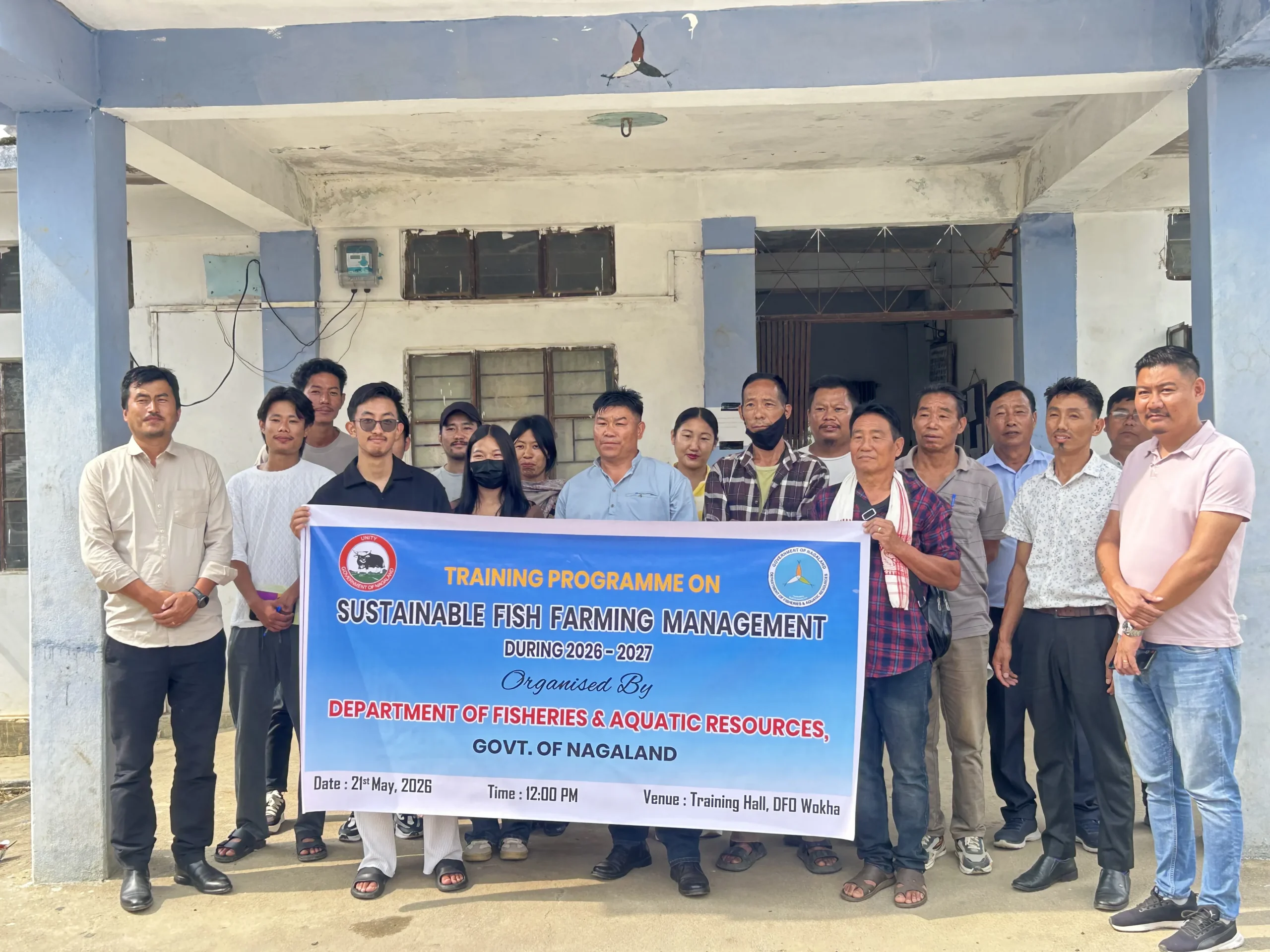
WOKHA, May 21 (NPN): A training programme on Sustainable Fish Farming Management was conducted on May 21 with the objective of promoting scientific fish farming practices and improving sustainable aquaculture management among fish farmers. The programme brought together officials, resource persons and participants to discuss efficient fish culture techniques, fish health management and integrated farming systems for better productivity and income generation.
Delivering the keynote address, DFO Rulanthung Ezung stressed the importance of adopting sustainable and scientific fish farming methods to ensure long-term economic benefits for farmers while also preserving aquatic ecosystems. He encouraged farmers to utilise available water resources effectively and highlighted the growing potential of fish farming as a reliable source of livelihood and nutritional security.
The first technical session was led by AFI Riimachang Aier, who spoke extensively on composite fish culture and pond management. Explaining the concept of composite fish culture, he stated that different species of fish can be reared together in the same pond because each species occupies different levels of water and has different feeding habits.
He explained that surface feeders, column feeders and bottom feeders should be selected carefully so that the fishes can coexist freely without disturbing each other’s growth. Catla was identified as a surface feeder, while Rohu and Grass Carp occupy the middle column of the pond, and Mrigal along with Common Carp remain at the bottom level. He noted that these species complement one another in the pond ecosystem, making composite fish culture both productive and economical.
Highlighting the ecological benefits of the system, the resource person stated that bottom-feeding fishes consume naturally available organic matter and help maintain the ecological balance of the pond, thereby reducing feed wastage and improving pond management. He further informed that around 8,000 to 10,000 fingerlings can be stocked in one hectare of water area while maintaining a balanced ratio of surface, middle-column and bottom-feeding species for optimum production.
The second technical session was conducted by AFI Khriezeto Zatsu, who focused on fish healthcare and post-stocking management practices. He explained that proper care after stocking is essential to reduce fish mortality and ensure healthy growth. He advised farmers to feed fishes approximately three to five percent of their body weight, depending on the growth stage, and cautioned participants against feeding during heavy rain as it could affect fish health and water quality.
He also emphasised that feed should always be provided at one particular location in the pond, as it helps farmers monitor feeding behaviour, observe the condition of the fishes and reduce wastage of feed. He further encouraged farmers to maintain hygiene in ponds, regularly check water conditions and observe fishes carefully for signs of disease or stress.
During the programme, officials informed participants that the state currently produces only around 30 percent of its fish demand, including fish required for consumption as well as ornamental and aquarium purposes. A demonstration on testing the pH level of water was also conducted for the trainees, where they were informed that excessively high pH levels above 9 are harmful for fish culture.
The programme also included an interaction and discussion session where participants exchanged experiences and sought clarification on various fish farming practices. The programme concluded with a vote of thanks proposed by FI Konri Magh.