
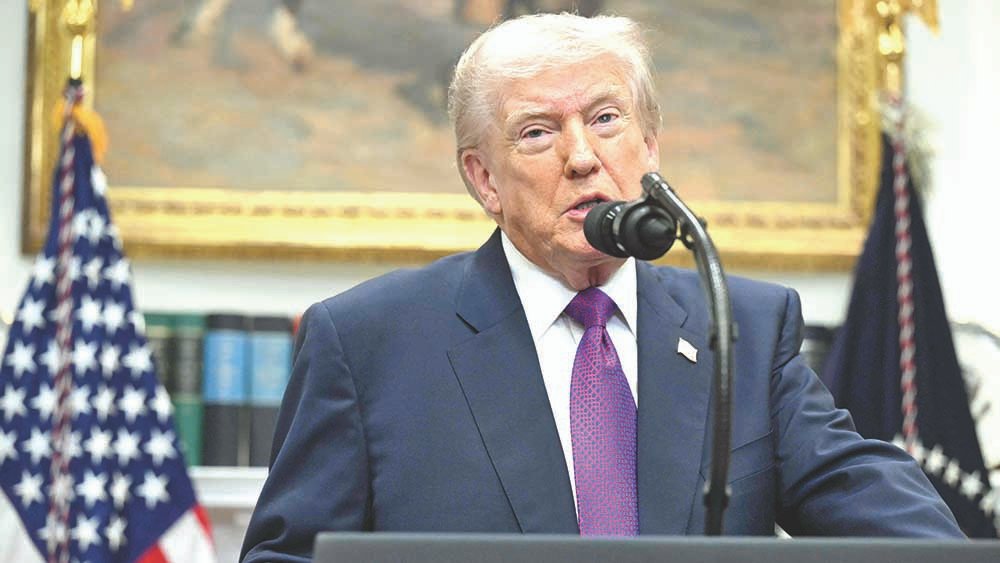
US President Donald Trump warned Iran to reach a nuclear agreement quickly or face serious consequences, saying failure to make a deal would be “very traumatic.”
“We have to make a deal otherwise it’s going to be very traumatic, very traumatic,” Trump told reporters at the White House.
“I don’t want that to happen, but we have to make a deal,” he added. Asked about a timeline, Trump said the process should move fast.
“I guess over the next month, something like that — shouldn’t take, I mean, it should happen quickly. They should agree very quickly,” he said.
Trump said if talks fail, the situation would escalate. “If they don’t make a deal, then it’ll be a different story,” he said.
“If the deal isn’t a very fair deal and a very good deal with Iran, then it’s going to be, I think, a very difficult time for them.”
The remarks followed a day after his meeting with Israeli Prime Minister Benjamin Netanyahu.
“We had a very good meeting yesterday with Bibi Netanyahu and he understands, but it’s ultimately up to me,” Trump said.
Asked whether Netanyahu wanted him to stop negotiating, Trump replied, “I’ll talk to them as long as I like and we’ll see if we can get a deal with them. And if we can’t, we’ll have to go to Phase 2. Phase 2 will be very tough for them.”
Trump did not spell out what “Phase 2” would involve.
The comments signal continued diplomacy but also renewed pressure on Tehran.
Iran’s nuclear program has remained a central flashpoint in West Asia. The United States withdrew from the 2015 nuclear deal during Trump’s first term. Since then, tensions have persisted over enrichment levels and regional security.
For India, stability in the Gulf region carries economic and strategic importance. India imports a significant share of its crude oil from West Asia and maintains a large diaspora presence across the region.
Any escalation between Washington and Tehran could have implications for energy markets and regional security dynamics. At the same time, US-Iran negotiations have historically moved in cycles of pressure and engagement, with diplomatic channels often kept open even during periods of sharp rhetoric.
2nd US aircraft carrier being sent to Middle East
The world’s largest aircraft carrier has been ordered to sail from the Caribbean Sea to the Middle East, a person familiar with the plans said Thursday, as US President Donald Trump considers whether to take possible military action against Iran.
The move by the USS Gerald R. Ford, first reported by The New York Times, will put two carriers and their accompanying warships in the region as Trump increases pressure on Iran to make a deal over its nuclear programme. The person spoke on condition of anonymity to discuss military movements.
The USS Abraham Lincoln aircraft carrier and three guided-missile destroyers arrived in the Middle East more than two weeks ago.
It marks a quick turnaround for the USS Ford, which Trump sent from the Mediterranean Sea to the Caribbean last October as the administration build up a huge military presence in the leadup to the surprise raid last month that captured then-Venezuelan President Nicolas Maduro.
It also appears to be at odds with Trump’s national security strategy, which put an emphasis on the Western Hemisphere over other parts of the world.
Trump told Axios earlier in the week that he was considering sending a second carrier strike group to the Middle East.
The USS Ford set out on deployment in late June 2025, which means the crew will have been deployed for eight months in two weeks time. While it is unclear how long the ship will remain in the Middle East, the move sets the crew up for an usually long deployment.
The White House didn’t immediately respond to a request for comment.