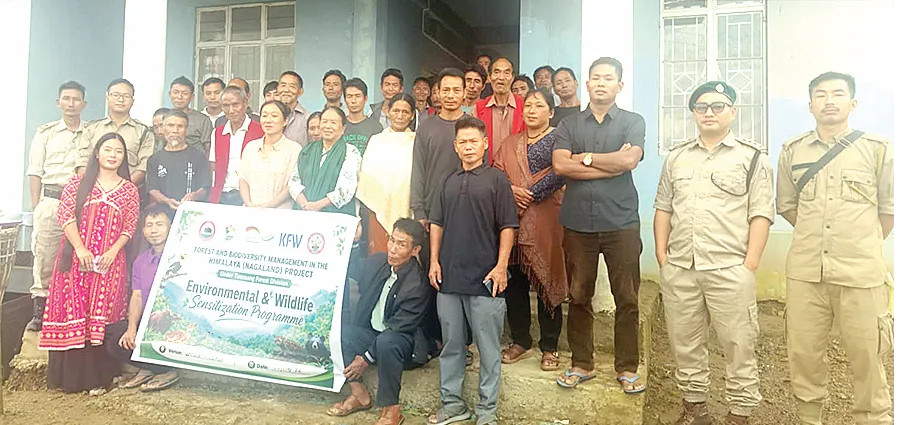
DIMAPUR: An Environmental & Wildlife Sensitization Programme was organised at Yali Village by the Tuensang Range, Tuensang Forest Division under the Forest and Biodiversity Management in the Himalaya (Nagaland) Project (FBMP).
The programme began with a Nature Education Training session led by the Project Implementing Agency (PIA), where participants engaged in a guided morning walk to identify local flora, fauna and wildlife signs, and to understand the broader forest ecosystem.
The indoor session was chaired by Bokashe Kinni (FGD). In his welcome address, L. Ngaku, head GB, expressed hope for improved coordination and sought departmental assistance for village development. Range Forest Officer Menya Wongto provided an overview of the project, commending the exemplary fund utilisation by Community Conservation Areas (CCAs) and Self Help Groups (SHGs). He announced that incentives and awards may be introduced for high performing CCAs, stressing trust and cooperation as vital for success.
Pastor A. Thungpang (YBC) spoke on the role of the church in environmental stewardship, noting that sermons on wildlife protection are regularly delivered in cooperation with the village council.
VCC M. Malem affirmed that the council is enforcing wildlife conservation through customary laws and strict penalties for violators.
Highlighting economic progress, CCA chairman S. Sangpa detailed revenue generation through Entry Point Activities (EPA) and ongoing Micro Plan fund initiatives, while announcing plans to form a new SHG. Representing women, Kundang Lemla emphasised the importance of women’s participation in forest and wildlife protection.
A technical session on illegal hunting and wildlife crime was conducted by Forester II Tiakaba Chang, who explained the Wildlife Protection Act (WPA) 1972, the Biodiversity Act 2002, and clarified that Article 371(A) does not permit indiscriminate exploitation of resources.
He reminded villagers that Nagaland remains under the purview of the Wildlife Protection Act and stressed responsibility in protecting natural resources.
The programme concluded with an interactive session, vote of thanks, mass benediction, photo session and lunch, marking a successful and engaging event.