Correspondent
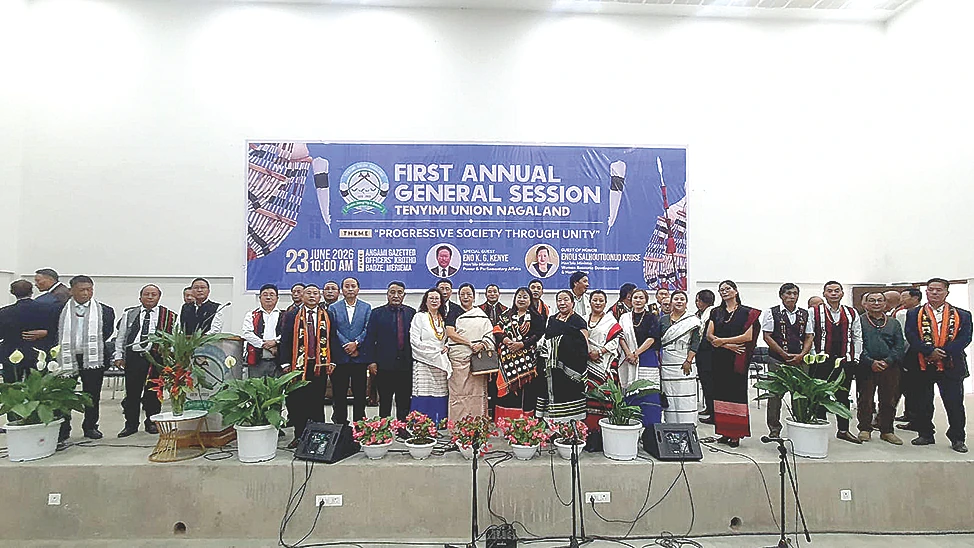
KOHIMA, JUN 23 (NPN): Tenyimi Union Nagaland (TUN) on Tuesday held its first annual general session on the theme “Progressive Society Through Unaity” at Angami Gazetted Officers Krotho, Badze, Meriema, where speakers underscored the need for unity, responsible leadership and collective action for the welfare of the Tenyimi people and the wider Naga society.
Addressing the gathering as special guest, minister for power and parliamentary affairs, KG Kenye, maintained that Tenyimi people were first and foremost Nagas and that the identity of Tenyimi community should never be placed above the larger Naga identity.
He stated that Tenyimi conglomerate was distinct from many other organisations because it was founded on ethnicity, ancestry, shared history and common forefathers rather than geographical or territorial boundaries. According to him, the Tenyimi tribes had remained closely knit through generations due to their common customs, traditions and way of life.
Kenye said the Tenyimi people had historically played a pivotal role in the growth of Naga society and had contributed significantly to the expansion of the Naga population and territory. He remarked that through changing times and circumstances, the community had remained steadfast and that much of the growth and evolution of Naga society had been influenced by Tenyimi unity.
Explaining the rationale behind the formation of TUN, Kenye said changing circumstances had created the need for a separate platform for the five Tenyimi tribes residing within Nagaland. He noted that unlike the broader Tenyimi family spread across different states and even international borders, the Tenyimi communities within Nagaland faced issues and challenges unique to their location and administrative realities.
He observed that the Tenyimi family today was divided by administrative and political boundaries across different states and countries, making it difficult for all sections of the community to arrive at common decisions on issues affecting them. He pointed out that government policies, schemes and administrative mechanisms were confined within specific territorial jurisdictions and often did not extend beyond those borders.
Kenye disclosed that discussions among legislators under the leadership of chief minister Neiphiu Rio had led to the conclusion that there was a need for an exclusive platform representing the Zeliang, Rengma, Pochury, Chakhesang and Angami tribes residing in Nagaland.
He clarified that TUN was neither a cultural organisation nor a political body but a platform intended to keep the people together, facilitate discussions on matters affecting the Tenyimi communities within the state and resolve issues through dialogue and mutual understanding.
While expressing satisfaction over the functioning of the outgoing office bearers, Kenye urged the organisation to exercise restraint and avoid actions that could hurt the sentiments of others or unnecessarily involve itself in political controversies. He cautioned against any tendency to overshadow other Naga communities and advised the organisation to remain balanced, logical and reasonable in its approach.
Referring to the present situation confronting the Nagas, Kenye described it as a critical juncture that would determine the future course of Naga society. He warned that prolonged uncertainty and the inability of Naga groups to arrive at a consensus on important issues had weakened societal cohesion.
According to him, there was an increasing erosion of discipline and collective responsibility, with many organisations and institutions no longer commanding the respect and obedience they once enjoyed. He said the decline of recognised centres of leadership and authority posed a serious threat to the future of Naga society.
He expressed hope that the new leadership of TUN would further strengthen unity among the Nagas and contribute towards ushering in peace and harmony.
Speaking as guest of honour, minister for women resource development and horticulture, Salhoutuonuo Kruse, said the Tenyimi people traced their origins to Makhel in present-day Manipur, which remained an important symbol of their common ancestry and historical connection.
She said that despite belonging to different tribes, villages and backgrounds, the Tenyimi people remained bound together by a shared history and common aspirations.
Stressing that unity, mutual respect and cooperation were essential for progress, she described TUN as a unique organisation founded on blood ties, brotherhood and shared cultural and linguistic heritage.
Kruse urged the community to strengthen dialogue, understanding and cooperation while guiding younger generations to uphold values such as character, compassion and service. She also called for stronger collaboration with other tribal and civil society organisations across Nagaland and appealed for continued efforts to promote peace and harmony.
In his presidential address, TUN president Kekhwengulo Lea said the Tenyimi people continued to remain united by their shared cultural heritage and ancestral roots despite being spread across different parts of the North-East.
The session also adopted four-point resolutions: The house welcomed the initiatives of the Nagaland Tribal Hohos Coordination Committee (NTHCC) in promoting Naga unity and safeguarding Naga rights and interests. It strongly condemned the killing of six Nagas in Manipur and demanded immediate arrest and exemplary punishment of those responsible.
The house expressed concern over the increasing incidence of crimes against women and children and demanded swift justice in all cases of sexual abuse. Another resolution pledged support for the promotion and development of Tenyidie and appreciated the efforts of Ura Academy in advancing the language to postgraduate and doctoral levels.
The session also announced a new team of office bearers for the tenure 2026-2029 with K.T. Vilie (APO) as president, Khinyi Woch (Rengma Hoho) as vice-president, Khriehuzo Lohe (CPO) as general secretary, Kerang (NZPO) as joint secretary, Neidilhou (Neibu) Sechü (APO) as publicity and information secretary, K. Mark (NZPO) as social and cultural secretary and Atathu Thurr (Pochury Hoho) as treasurer.
Earlier, the programme was chaired by Mishento Apon. Greetings were delivered by Tenyimi People’s Organisation president Adv. Timikha Koza, while advisor, NSDMA and Inland Waterways, Z. Nyusietho Nyuthe, also addressed the gathering.
The resolutions were adopted by Resolution Committee convenor Khinyi Woch and the new office bearers were declared by Nomination Committee convenor Thejao Vihienuo. Various cultural presentations were also held during the programme.