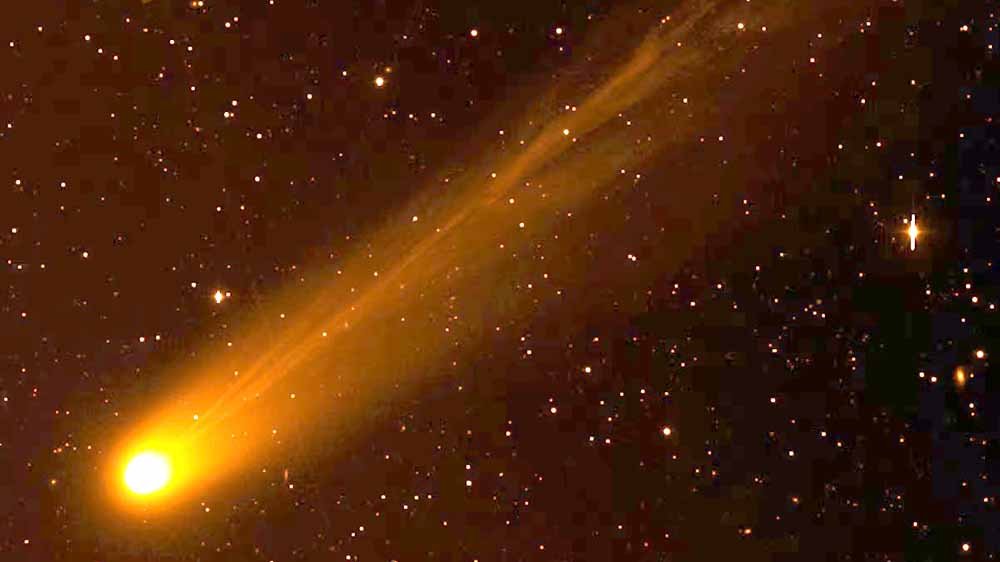
Two newly discovered comets are streaking across the sky in a spectacular display as they make their closest approaches to Earth this month.
Comets are made of ice, frozen gases and rock, and as they travel near stars such as the sun, heat causes them to release gas and dust, which creates their signature tails.
Researchers spotted the comet C/2025 A6 Lemmon January 3, while C/2025 R2 SWAN was only recently detected for the first time on September 10 during its close approach to the sun, according to Qicheng Zhang, a postdoctoral fellow studying small body astronomy at Lowell Observatory in Flagstaff, Arizona.
For eager sky-gazers, it’s a great time now to spot the comets with binoculars or telescopes because they both have long-period, oval-shaped orbits that take them around the sun, meaning they’ll only be in proximity of Earth for a limited time.
Comet SWAN won’t reappear for another 650 to 700 years, while Lemmon will remain out of sight for 1,300 years, said Carrie Holt, postdoctoral fellow and astronomer at Las Cumbres Observatory, a global network of observatories. “SWAN is only observable in early evenings — right after the sky has become dark,” wrote Quanzhi Ye, associate research scientist in the department of astronomy at the University of Maryland, in an email.
“Lemmon is now visible right before sunrise, but will soon become visible in the evenings and evenings only.”
Both comets appear near the sun as viewed from Earth, so there’s only a short window each day to observe them, Ye added.
SWAN will make its closest approach to Earth — coming within 24 million miles (38.6 million kilometers) of us — on October 20, while Lemmon will swing within 55 million miles (88.5 million kilometers) of our planet on October 21, Ye said.
Astronomers are trying to observe both to learn more about long-period comets, which have orbits lasting 200 years or longer.
Long-period comets have spent most of their time at the frigid edge of our solar system in the Oort Cloud, a spherical shell of icy bodies, Holt said. These comets likely formed near giant planets such as Jupiter and Saturn before receiving a gravitational kick to the solar system’s outskirts billions of years ago — where they’ve been preserved in deep freeze ever since, she added.
“When one gets nudged back toward the sun, we’re seeing materials that have barely changed since the solar system’s beginning,” wrote Holt in an email.
“As their ices start to sublimate (change from a solid to a gas), we get a glimpse of the original building blocks of our solar system and a chance to learn how planetary systems like ours come together.” Lemmon is visible to those living in the Northern Hemisphere, while SWAN favors sky-gazers in the Southern Hemisphere — but it’s becoming visible in the Northern Hemisphere, too, Ye said.
Lemmon is expected to brighten a little more in the coming weeks through early November, while SWAN will likely be fading rapidly soon, he added.
Comet Lemmon will hide behind the sun in November and December, then become visible only for observers in the Southern Hemisphere afterward, Ye said. Ukrainian amateur astronomer Vladimir Bezugly discovered Comet SWAN through images captured by the Solar Wind ANisotropies, or SWAN, instrument aboard the Solar and Heliospheric Observatory spacecraft, a joint NASA-European Space Agency project to study the sun.
Meanwhile, Lemmon was spotted by the Mount Lemmon Observatory in Arizona as part of the Catalina Sky Survey, a NASA-funded project that scans the night sky for near-Earth objects such as asteroids that could pose a risk to Earth.
(CNN)