
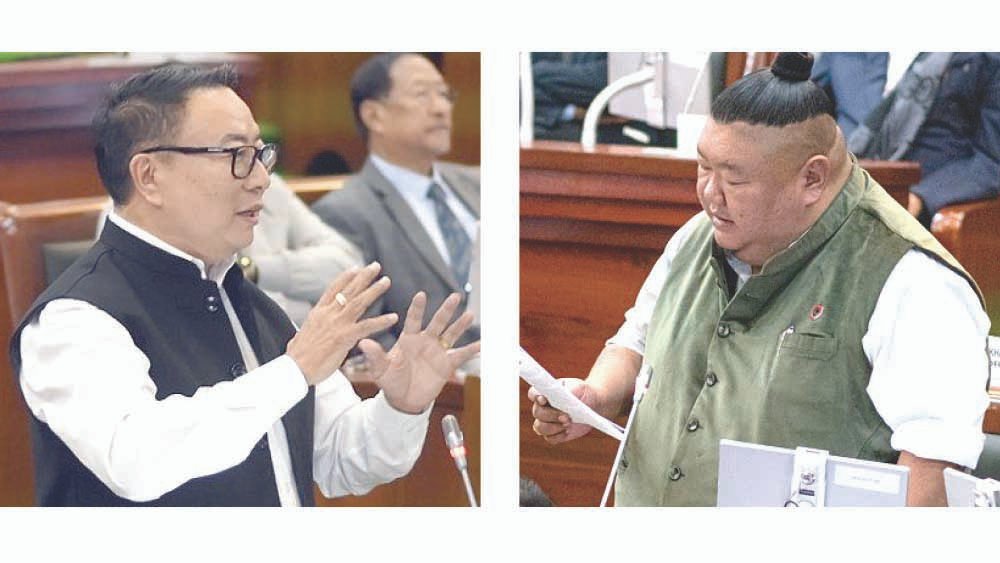
Nagaland People’s Front legislator Kuzholuzo (Azo) Nienu, had initiated the debate on the Motion of Thanks to the Governor’s Address on March 3 and strongly opposed the recitation of Vande Mataram in the Assembly.
Calling it “unprecedented” in his 24 year tenure, Azo argued that the Ministry of Home Affairs order does not specifically mention legislatures.
He asserted that, as Christians, “we cannot serve two masters,” and cited Article 371(A), which safeguards Naga religious and social practices unless resolved by the Assembly. Placing his dissent on record, Azo described the directive as an imposition on their faith.
Along intercedes: Seeking to ease tensions over the recitation of Vande Mataram in the Nagaland Assembly, BJP legislator Temjen Imna Along urged members to view the national song in its historical and secular context. He reminded that Vande Mataram, composed by Bankim Chandra Chatterjee in the 1870s, was adopted by the Constituent Assembly in 1950 as the national song, symbolizing India’s struggle against colonial rule.
Along acknowledged that India’s diverse population interprets the motherland through different cultural lenses—Durga as a fighter, Saraswati as a giver of knowledge, and Lakshmi as a provider of wealth. “I am not here to justify, but at least we can all respect the sentiment of the nation,” he said, stressing that the song should not be seen as a religious imposition.
Drawing from his own experience as a Christian educated in missionary schools, Along recalled how students of different faiths joined in Christian prayers with respect. He argued that secularism is about accepting and respecting each other’s thought processes, not rejecting them.
He further clarified that the directive should not be interpreted as infringing Article 371(A) or Christian faith. Instead, he urged legislators to treat Vande Mataram as a national song deserving of respect. “Whenever it is sung, it is our duty as citizens of this country to give the best respect that we can give,” he emphasized.
His remarks came amid strong objections from several members, highlighting the ongoing debate over the song’s place in Nagaland’s legislative proceedings.
Reviving a debate: The debate resurfaced during the 150th anniversary of “Vande Mataram” after Ministry of Home Affairs (MHA) pushed for use of the full version. The Opposition accused the BJP-led government of “rewriting history,” particularly ahead of the West Bengal elections, and ignoring the inclusive consensus of founding leaders.
In 1937, the Congress Working Committee, backed by Mahatma Gandhi and Jawaharlal Nehru, recommended singing only the first two stanzas. On January 24, 1950, the Constituent Assembly adopted this truncated version, omitting references to Hindu goddesses. President Rajendra Prasad declared “Jana Gana Mana” the National Anthem, while granting “Vande Mataram” equal honour.