
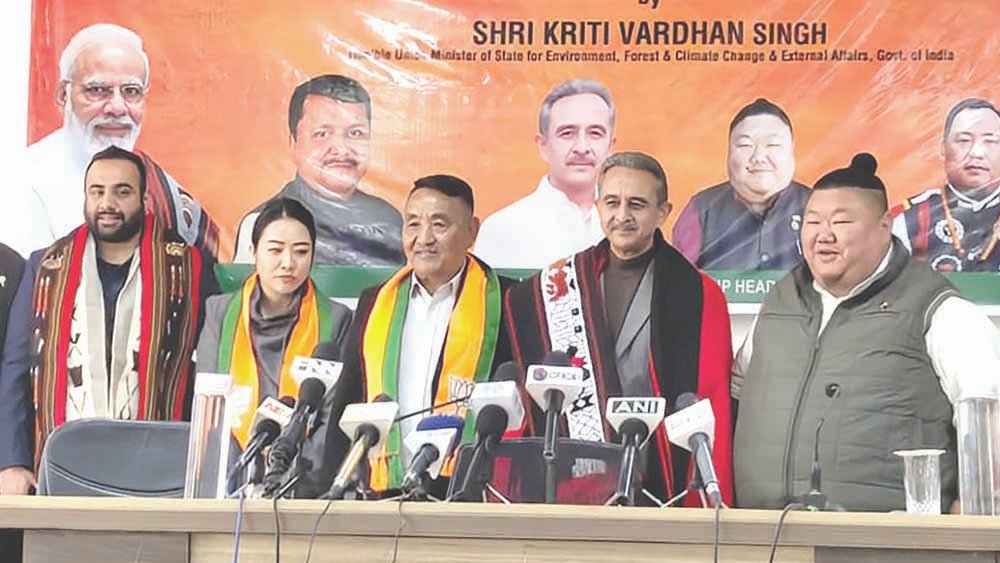
Union Minister of State for Environment, Forest and Climate Change, and External Affairs, Kriti Vardhan Singh, on Monday described the Union Budget for FY 2026–27 as a reflection of the Modi government’s commitment to decisive action, structural reforms, and people-centric development, guided by the principle of “Atmanirbhar Bharat.”
Addressing a press conference at BJP headquarters in Kohima, Singh termed the budget—presented for the first time from Kartavya Bhavan—as a “Yuva Shakti-driven” exercise, inspired by ideas from the Viksit Bharat Young Leaders Dialogue 2026.
He outlined three key kartavyas (duties) anchoring the budget: accelerating and sustaining economic growth through enhanced productivity and competitiveness; fulfilling people’s aspirations by building their capacity as partners in national prosperity; and developing cutting-edge technologies, including artificial intelligence, as force multipliers for better governance.
These priorities aim to ensure every family, community, region, and sector has access to opportunities and resources, he said.
Singh noted that the budget advances the “Reform Express” roadmap toward Viksit Bharat@2047, building on over 350 reforms since Independence Day 2025.
MoS said the government would continue deregulation, reduce compliance burdens, and promote trust-based governance.
Key proposals include a safe harbour provision for emerging technologies, a high-level committee to review non-financial sector regulations, and the introduction of Jan Vishwas Act 2.0 to decriminalise offences and improve ease of living.
Singh highlighted a high-level committee on banking to align the sector with India’s next growth phase, noting strong balance sheets, improved asset quality, and record profitability in Indian banks.
On fiscal management, Singh said the government has maintained stability, discipline, and moderate inflation amid global uncertainties. The fiscal deficit has been set at 4.3% of GDP in BE 2026–27, meeting the commitment to keep it below 4.5%. The debt-to-GDP ratio is estimated at 55.6%, with a medium-term target of 50% ±1% by 2030–31. Gross market borrowings stand at Rs.17.2 lakh crore and net borrowings at Rs.11.7 lakh crore, ensuring balanced credit flow to the private sector.
He added that accepting the 16th Finance Commission’s recommendation to retain 41% vertical devolution has resulted in Rs.1.4 lakh crore in grants to states, while fiscal prudence has improved India’s sovereign outlook with global rating agencies.
For middle-class relief, Singh said the budget builds on “Vivad se Vishwas,” extending last year’s zero income tax up to Rs.12 lakh. Measures include simplified new tax regime rules, redesigned ITR forms, staggered filing deadlines, extension of revised return filing to March 31 with nominal fees, and integration of assessment and penalty proceedings to reduce litigation.
TCS under the Liberalised Remittance Scheme for education and medical purposes has been reduced to 2%, and basic customs duty exempted on 17 drugs, with additional rare diseases included for duty-free personal imports. PROIs can now invest up to 10% in equity of listed Indian companies.
On employment and skilling, he said a high-powered Education-to-Employment and Entrepreneurship Standing Committee would position the services sector as a core growth driver, targeting 10% global share by 2047. Professional bodies like ICAI, ICSI, and ICMAI will offer short-term modular courses to create “Corporate Mitras,” especially in tier-2 and tier-3 towns.
MoS said the budget proposes five university townships near major industrial and logistics corridors and expansion of allied health institutions to add one lakh health workers over five years.
In education, Singh said a National Institute of Hospitality will upgrade the National Council for Hotel Management and Catering Technology. AVGC sector will gain from content creator labs in 15,000 schools and 500 colleges, plus a new National Institute of Design.
For MSMEs, he said a three-pronged approach covers equity, liquidity, and market access: a Rs.10,000 crore SME Growth Fund, Rs.2,000 crore top-up for Self Reliant India Fund, and mandatory TReDS for CPSE purchases from MSMEs.
Other measures include credit guarantee for invoice discounting, GeM–TReDS linkage, and a secondary market for TReDS receivables.
Manufacturing would scale in seven strategic sectors, with initiatives like the Rs.10,000 crore Biopharma SHAKTI programme, Mega Textile Parks, container manufacturing scheme, high-tech tool rooms, construction equipment scheme, sports goods initiative, and revival of 200 legacy industrial clusters.
Infrastructure capex rises to Rs.12.2 lakh crore in 2026–27, with proposals for an Infrastructure Risk Guarantee Fund, REIT-based monetisation of CPSE real estate, new freight corridors, national waterways expansion, coastal cargo promotion, ship repair hubs at Varanasi and Patna, and incentives for seaplane manufacturing and operations.
MoS informed that exports would be boosted via an Export Promotion Mission, BharatTradeNet digital platform, Global Capability Centres in tier-2 cities, and upgraded air cargo infrastructure. He said that Mission Purvodaya for Eastern India includes the East Coast Industrial Corridor, tourism destinations, e-buses, educational institutes, rare earth corridors, and freight connectivity.
For rural India, the Mahatma Gandhi Gram Swaraj Initiative strengthens khadi, handloom, and handicrafts, while a loan-linked subsidy scheme expands veterinary infrastructure.
Urban development focuses on “growth connectors” through City Economic Regions (₹5,000 crore per CER over five years) and seven high-speed rail corridors.
The semiconductor ecosystem gains from ISM 2.0, increased electronics manufacturing outlay, and rare earth corridors in mineral-rich states.
Agriculture emphasises high-value crops, oilseed self-reliance, fisheries, and livestock entrepreneurship, supported by Bharat-VISTAAR, a multilingual AI advisory platform.
Women-led development advances via SHE-Marts, enterprise support, and a girls’ hostel in every district. Social justice includes enhanced aid for divyangjans through skill training, assistive tech manufacturing, and PM Divyasha Kendras expansion.
On climate and energy, MoS said Rs.20,000 crore was earmarked for CCUS technologies, with customs duty exemptions for battery, solar, and nuclear manufacturing.
Heritage, tourism, and wildlife conservation feature development of 15 archaeological sites, a National Destination Digital Knowledge Grid, eco-tourism trails, upskilling of 10,000 tourist guides, and hosting the first Global Big Cat Summit under the International Big Cat Alliance.
Responding to a query, Nagaland Minister for Tourism and Higher Education Temjen Imna Along addressed the long-pending Dimapur Airport expansion issue due to land occupation by Assam Rifles. He said the matter, discussed in a recent state cabinet meeting, falls under AAI and Ministry of Home Affairs jurisdiction, while the state is tackling civilian encroachments and pursuing resolution with the Centre.
Singh offered central assistance if needed for follow-up or coordination.
He highlighted recent state initiatives, including Dimapur Railway Station upgrades and “Krishi Udan” facilities at airports for affordable agricultural transport.
On Nagaland’s potential, Singh praised its strong community structure and eco-forests but stressed the need for structured training in quality and sustainability. He called for NGOs and institutions to develop eco-tourism projects like boat trails and eco-trails for livelihood generation, particularly benefiting youth and women, and assured support through central schemes.
FNTA to fast-track peace, autonomy, development: MoS Kriti Vardhan
KOHIMA, FEB 9 (PTI): The signing of the Frontier Nagaland Territorial Authority (FNTA) agreement marks a decisive step toward peace, autonomy, and accelerated development in the eastern part of the state, Union Minister Kirtivardhan Singh said on Monday.
Addressing the press at the BJP state headquarters in Kohima, Singh said the agreement, signed on February 5 between the Ministry of Home Affairs, the Nagaland government, and the Eastern Nagaland People’s Organisation (ENPO), will enable region-specific decision-making and faster execution of development programmes across the six eastern districts.
He said the FNTA has been granted administrative autonomy with 46 subjects devolved to the authority, a dedicated secretariat, and a separate annual budget funded by the Centre, allowing development priorities to be determined locally.
Singh, the MoS for Forest, said that the agreement will strengthen peace and stability, creating the necessary conditions for infrastructure development, investment, tourism, and employment generation in eastern Nagaland.
He said the FNTA framework reflects the Centre’s broader approach toward the Northeast, noting that since 2019, the government has signed over 40 peace and development agreements with various groups in the region.
“Peace and development must move together. Once stability is ensured, people can focus on growth, livelihoods, and entrepreneurship,” he said.
Singh said he would look into the long-pending issue of the expansion of the Dimapur Airport, the only commercial airport in the state, continues to be pursued.
State Tourism Minister Temjen Imna Along said that land occupied by the Assam Rifles training centre is under the jurisdiction of the Airport Authority of India and the Ministry of Home Affairs.
The state government has already allotted alternate land for relocation, and the Centre is following up to facilitate expansion, including the possibility of handling international flights in the future, he said.
Singh said Nagaland would benefit from the Union Budget’s provisions, targeting eco-tourism and rural livelihoods, including schemes for developing sustainable mountain trails, forest trails, bird-watching circuits, and homestay-based tourism.