
The concluding day of “The White Owl Literature Festival & Book Fair” on Saturday featured a series of diverse sessions that explored contemporary issues ranging from podcasting and artificial intelligence to Northeast identity, mental health, fiction writing, Korean culture and oral storytelling traditions.
Organised by Penguin Random House India (PRHI) in collaboration with The White Owl, the festival was held under the theme “Celebrating Stories, Inspiring Minds,”at Zone Niathu by the Park, Chümoukedima.
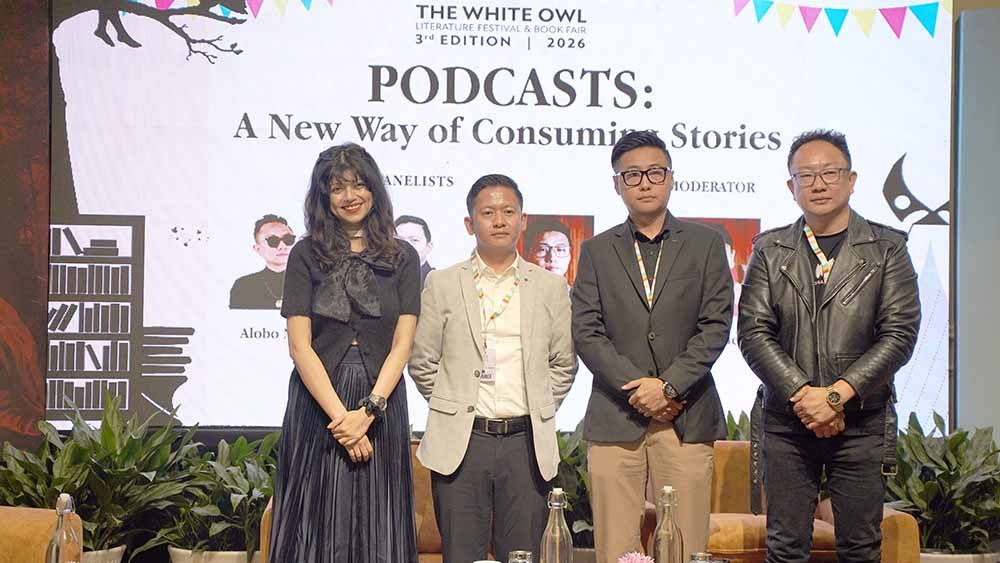
The final day began with a session titled “Podcasts: A New Way of Consuming Content” moderated by singer, songwriter and author Malini Banerjee.
Panelists included singer-songwriter Alobo Naga, political commentator and host of The Lungleng Show R. Lungleng, and Shout Out Media founder and podcast host Asalie Peseyie.
Peseyie shared that his podcast journey began during the COVID-19 lockdown, when he experimented with audio storytelling to share stories of fellow Nagas. He emphasised the importance of using podcasts to discuss difficult issues, noting that conversations become more accessible when openly addressed. He reminded creators to focus on purpose rather than numbers, stressing dialogue over virality.
Alobo Naga traced his podcast idea back to 2015–16 during his tours, initially conceived as a backstage project but later revived. He explained that podcasting allowed him to reach audiences beyond his music, offering a platform to raise awareness and share perspectives. He highlighted monetisation opportunities, noting that consistent content and growing viewership attract brand sponsorships and advertising revenue, especially with global audiences.
R. Lungleng recounted his inspiration from research in Europe, where he saw gaps in development models and turned to podcasting to communicate issues directly to policymakers. He stressed the importance of fact-checking, transparency and inviting diverse viewpoints to strengthen public discourse. He described podcasts as a personal and authentic form of storytelling, calling them a new form of journalism that respects audience intelligence.
The discussion reflected on challenges of sustainability, audience sensitivity and creative burnout, while acknowledging podcasting as a digital extension of traditional oral storytelling practices.
Another session, “Becoming Human in the World of Artificial Intelligence (AI),” was moderated by Brainerd Prince of Plaksha University with panelists Prof. Rajesh Sharma, Barsali Bhattacharyya and Siddharth. They traced AI’s origins to the post-World War II Turing Test and explained it as a pattern-recognition system trained on large datasets.
Panelists discussed AI’s impact on productivity and disruption of traditional roles, noting that disruptive technologies historically create new opportunities. They emphasised co-creating with AI rather than competing against it, citing examples of entrepreneurs and filmmakers using AI to enhance efficiency.
On education, they cautioned that while AI can boost individual creativity, it may reduce collective creativity when students rely on similar outputs. Students were advised to use AI for research but ensure drafts remain human-written.
Panelists also addressed AI bias, explaining that it mirrors human society and cultural norms embedded in data. They stressed that empathy, creativity and imperfection remain uniquely human qualities, warning against over-reliance on AI which could worsen loneliness. The session concluded that AI is here to stay, but humans must remain in control to ensure it serves inclusive and humane futures.
The session “Northeast: Culture, Identity & Belonging” moderated by curator and cultural consultant Anungla Zoe featured Dimasa cultural practitioner Avantika Haflongbar, writer and civil servant Daribha Lyndem, and curator Pooja Elangbem. They reflected on the role of literature in preserving traditions, navigating identity and fostering belonging in a diverse region.
A panel on “Mental Health & Wellbeing” moderated by PRHI commissioning editor Archana Nathan featured Dr. Tanaya Narendra (popularly known as Dr. Cuterus), Riri G. Trivedi and Ellen Konyak. They discussed challenges of mental health awareness in close-knit societies, emphasising the importance of open dialogue, community support and professional guidance.
The session “Fiction vs Non-Fiction: Does the Line Still Matter?” brought together Nagaland-based writer and photographer Huthuka Sumi, writer Daribha Lyndem and historian Probal Dasgupta. They debated the blurred boundaries between fiction and non-fiction, noting that storytelling often transcends rigid categories to convey truth and imagination simultaneously.
Another session on “Korean Culture: The Hallyu Wave and Why It Resonates” moderated by Saumya Jha featured Malini Banerjee and lawyer-entrepreneur Nikita Engheepi. They discussed the global appeal of Korean music, drama and culture, highlighting its resonance with younger audiences and its role in shaping contemporary cultural exchanges.
The festival concluded with “Stories by the Sacred Fire,” an oral storytelling session featuring Ariba Anar, Pinglang and Tingyineu Haibwang. The closing programme was jointly held by author Easterine Kire and independent researcher-editor Vizovono Elizabeth, who reflected on the festival’s journey and its role in celebrating diverse voices.
The three-day festival brought together writers, thinkers, artists and audiences to celebrate storytelling in its many forms. From podcasts and oral traditions to AI and cultural identity, the sessions underscored the power of dialogue, creativity and inclusivity in inspiring minds and shaping narratives for the future.
White Owl Fest ends with dialogues on storytelling, AI, culture
Staff ReporterDIMAPUR, FEB 7 (NPN)