
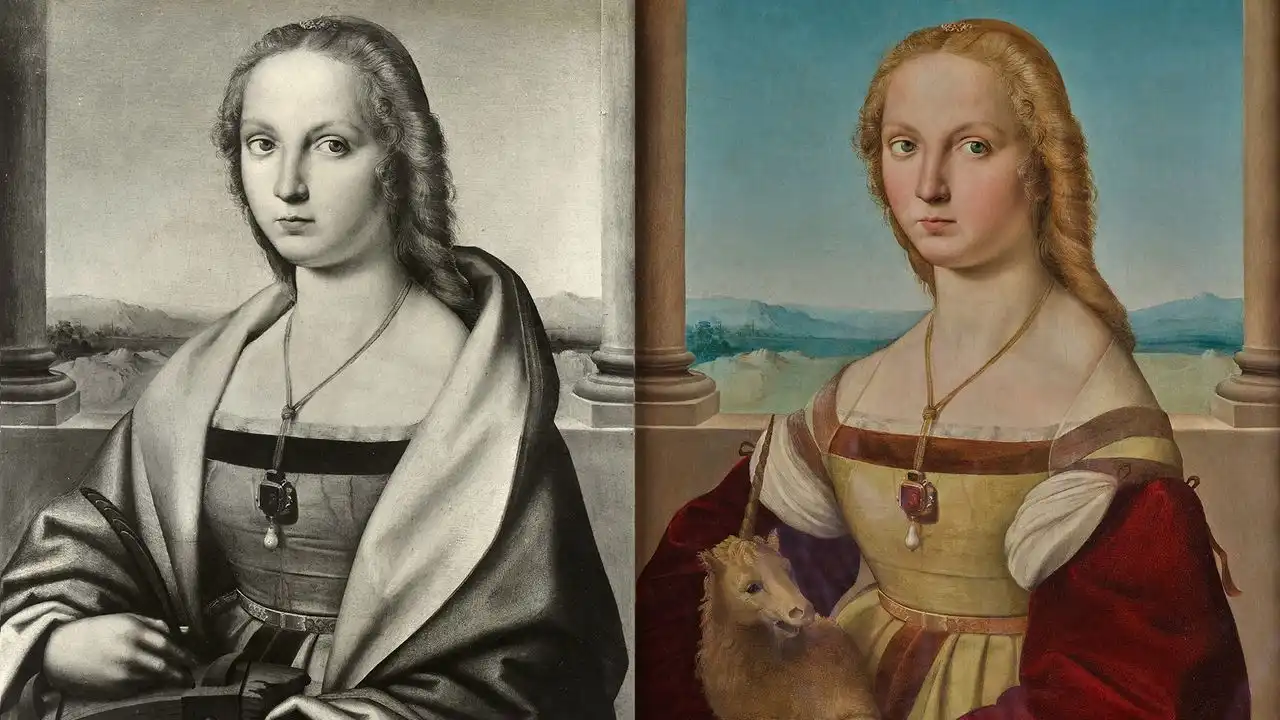
Overpainted images found hidden inside Raphael’s Portrait of a Young Woman with a Unicorn help unlock the mystery behind it. They also show the ways that the image of the ideal woman has been carefully controlled by men through the centuries.
What do you get when you cross a mythical creature from folklore with a medieval torture device? The answer is one of the most intriguing portraits in all of art history: Raphael’s Portrait of a Young Woman with a Unicorn – a restless masterpiece that refuses to stay still.
Originally painted by the precocious Italian master between 1505 and 1506, the work’s surface has, over the centuries, repeatedly been painted over, each time to tell a different story. While the true identity of the woman that Raphael depicts remains a mystery to this day, she has been made to embody shifting ideals of femininity: from a chaste avatar of marital fidelity to a pious saint sitting beside a spiked execution wheel. The painting has, quite literally, struggled to keep its story straight.
The anti-Mona Lisa
At first glance, the likeness we encounter today appears deceptively straightforward. The sitter’s three-quarter pose, her folded hands, and her placement before a soft, receding landscape echo – if perhaps a little too deferentially – the composition of the Mona Lisa, begun by Leonardo da Vinci just a few years earlier.
Raphael, who is thought to have studied the Mona Lisa in Florence, borrows the structure of his renowned contemporary’s groundbreaking portrait but makes it his own by stripping away the Mona Lisa’s enigmatic aura and smoky air of ambiguity. Wiped clean are the sfumato haze, the rocky terrain and meandering waters, not to mention her entrancingly inscrutable smile. Raphael has replaced them with coolness and clarity. In his portrait, the eyes are icier – the stare frostier.
The virgin and the unicorn
So chilly is the blue-steel gaze of Raphael’s work, in fact, it risks rebuffing the viewer’s. One could easily overlook altogether the mute neigh of the tiny wild unicorn (crouching in the bottom left hand corner of the painting) that the young woman has managed gently to restrain in her arms. Sown quietly into the fabric of the work, the playful unicorn does heavy symbolic lifting with its spiralling horn in establishing the work’s original meaning. The creature’s association with chastity and the legend that only a virgin could tame it had already been seized upon by many of Raphael’s contemporaries, including the makers of the famous Hunt of the Unicorn tapestries, just completed in Brussels, and Da Vinci, who created two drawings on the subject. (BBC)
In the light of that established symbolism, it is likely the painting was initially conceived and commissioned as a betrothal or marriage portrait, designed to project the young woman’s inviolable virtue and suitability for marriage. Whether or not, as some scholars speculate, she is really 13-year-old Laura Orsini della Rovere, whose family famously employed the unicorn as its emblem, her true identity is arguably incidental.
She has been transmuted – exalted by Raphael into an archetype – a universal ideal of virginal femininity. More crisply cut and brightly lit than the mystifying Mona Lisa, whose very essence is the soul of shadowy enigma, Raphael’s sitter seems as solidly fixed before us, whoever she is, as the oversized ruby and dangling drop pearl that tug at her necklace, which tether her beauty to the heft of male-provided material comforts. She’s a set stone. Or is she?