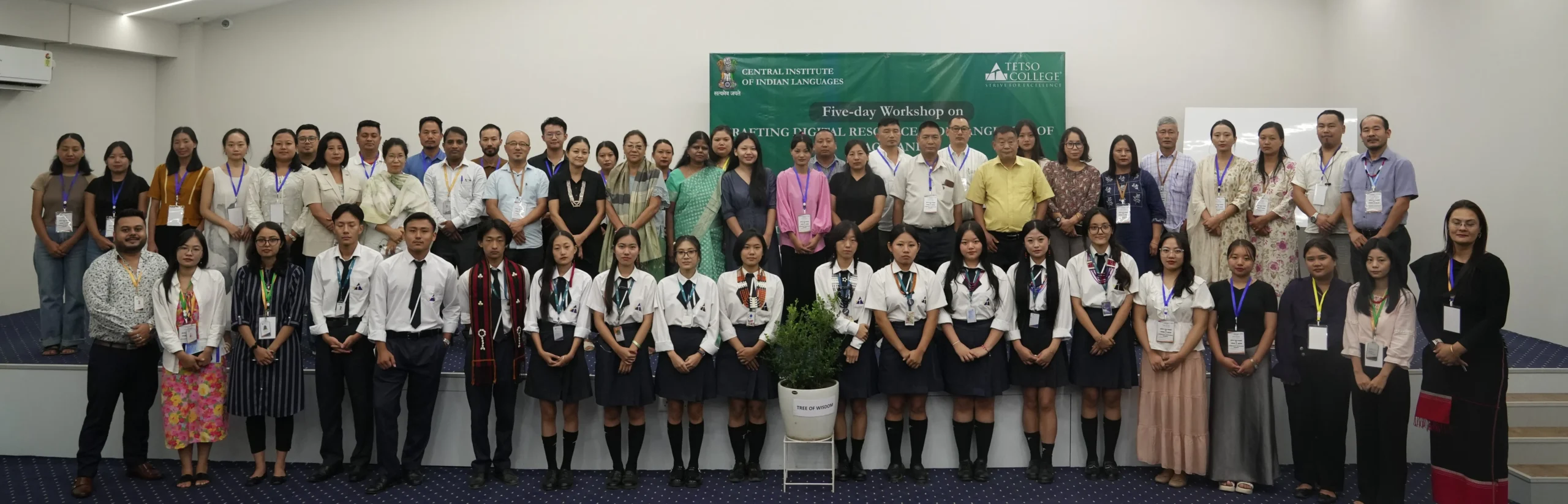
DIMAPUR: A five day national workshop on “Crafting Digital Resources for Languages of Nagaland” began at Tetso College, Sovima, on Tuesday, bringing together native language speakers, community resource persons, linguists, language teachers and technology experts to strengthen the digital presence of indigenous languages of the State.
Organised jointly by the Central Institute of Indian Languages (CIIL), Mysuru, through the Centre of North Eastern Language Development (C NELD), and the Department of Linguistics, Tetso College, the workshop will continue till August 22.
The initiative aims to develop prototype digital language resources for 12 languages of Nagaland by combining community knowledge, linguistic expertise and technological skills. These resources are intended to support language learning, documentation, intergenerational transmission and wider digital engagement.
The inaugural programme was chaired by Dr. Asenla Yanger, HoD English, Tetso College. Padma Shri awardee and State Convenor of INTACH, Nagaland Chapter, Sentila T. Yanger attended as chief guest. Prof. Umarani Pappuswamy, Deputy Director and Programme Coordinator, CIIL, Mysuru, Dr. Hewasa L. Khing, Principal, Tetso College, faculty members, linguists, technical experts, community representatives and students were also present.
In his welcome address, Dr. Wichamdinbo Mataina, HoD Linguistics, Tetso College and Programme Coordinator, stressed the need for indigenous languages to have a meaningful presence in the digital world. He cautioned that languages rich in history, songs, stories and cultural identity risk declining visibility if absent from digital platforms, noting that each language faces unique challenges.
Chief guest Sentila T. Yanger highlighted the close link between language, cultural identity and intergenerational transmission. Expressing concern over the shift towards dominant languages among urban youth, she emphasised that language carries the memories, traditions and worldview of a community. She pointed to the potential of digital technologies such as dictionaries, archives, fonts, keyboards and AI based transcription, translation and speech recognition, but cautioned that technology alone cannot preserve languages without active community use.
Introducing the workshop, Prof. Umarani Pappuswamy explained that while some indigenous languages have been documented, many remain under documented and low resourced digitally. She said the rapid growth of AI has widened the digital divide into a language divide, and stressed the need for inclusive, community oriented approaches.
Participants will work on prototype resources for 12 languages using a core set of 500 words, 20 phrases and 50 example sentences, along with audio and linguistic data. Digital resources being explored include a talking children’s dictionary, vocabulary activities, language games, quizzes, phrase and sentence resources, listening and speaking activities and a digital starter kit.
Tetso College principal Dr. Hewasa L. Khing welcomed the initiative, linking it to the International Decade of Indigenous Languages (2022–2032), Tetso College’s Vision 2030 and the college’s digital archive NEIIPA. A total of 26 native speakers and community resource persons, eight linguists, two language teachers and three software developers are participating. Practical sessions began Tuesday afternoon with data collection, verification and conversion into digital formats.
Organisers said the resources developed would provide a foundation for future expansion, incorporating additional vocabulary, stories, dialogues, images and learning activities. The larger objective is to establish a sustainable digital presence for Nagaland’s languages and develop a model for similar initiatives across Northeast India.