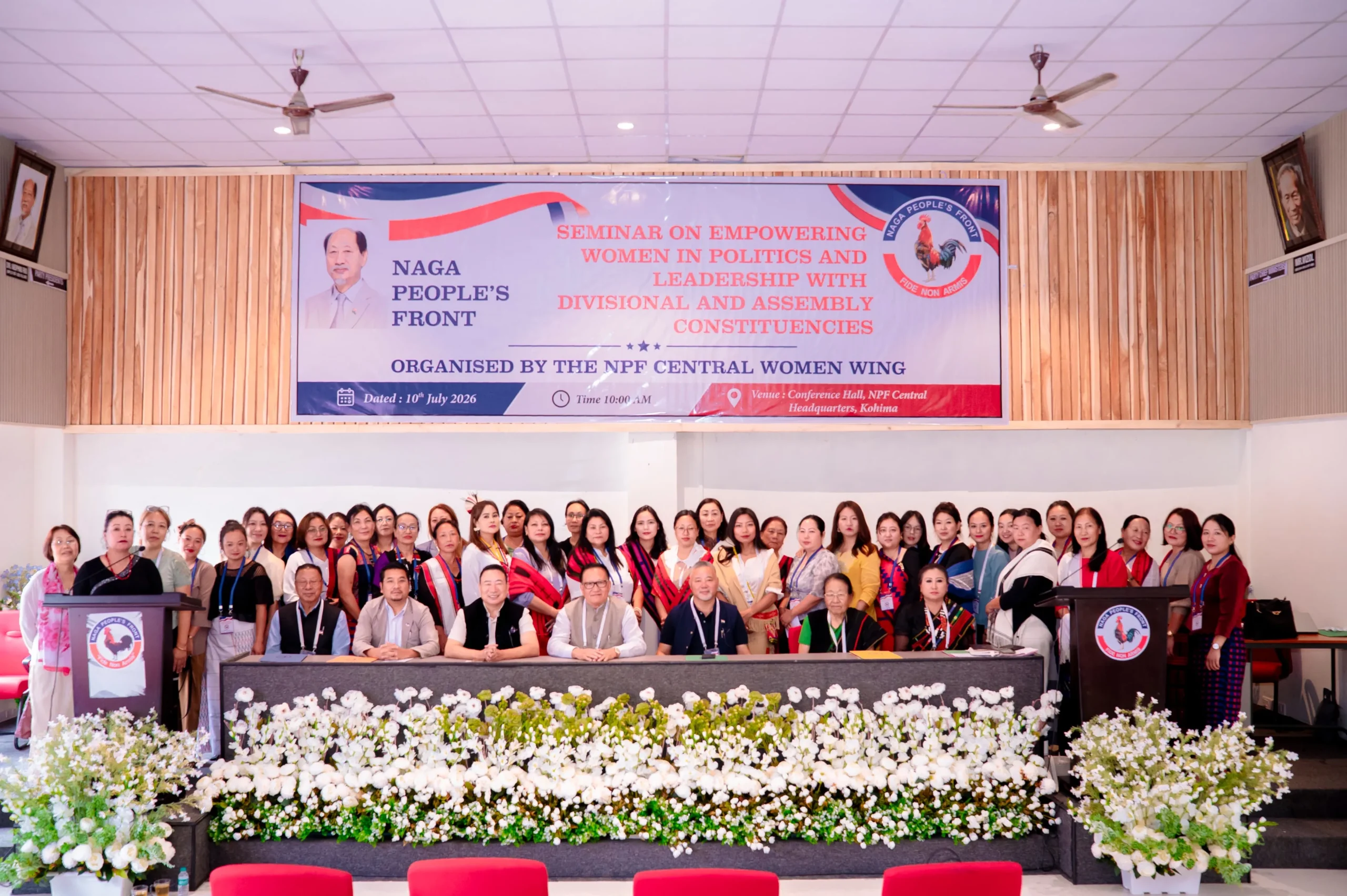
DIMAPUR: Deputy Chief Minister, T.R. Zeliang, called for creating safe spaces and stronger voices for women in politics while addressing a seminar on “Empowering Women in Politics and Leadership” organised by the NPF Central Women Wing under the theme “Safe Spaces, Strong Voices: Navigating Politics as Women”, on July 10.
Congratulating the organisers, Zeliang said the theme reflects a vital truth-that when women feel safe, respected and supported, they lead with confidence and contribute meaningfully to society. He emphasized that safe spaces are not merely physical environments but platforms where women can express their views without fear of discrimination, where ideas are judged on merit and leadership nurtured through equal opportunity.
Pointing out that women constitute nearly half of India’s population, Zeliang noted that their representation in Parliament remains limited, with only 74 Members in the Lok Sabha (13%) and 42 Members in the Rajya Sabha (17%). While this marks progress compared to the early years of the nation, he said much more needs to be done before political institutions truly reflect the diversity of society.
In Nagaland, the journey has been equally challenging. The State witnessed no representation of women in the Legislative Assembly until the 2023 elections, when Salhoutuonuo Kruse and Hekani Jakhalu broke historic barriers, inspiring young women to pursue political leadership.
Zeliang reminded that Naga women have always been leaders-backbones of families, custodians of culture, active participants in churches and advocates for peace. Organisations like the Naga Mothers Association, he said, have shown courage in promoting harmony during difficult times, proving that leadership is measured not only by elected office but also by service and compassion.
He further said that for many years, the issue of women’s reservation in Urban Local Bodies (ULBs) remained one of the most debated and contentious topics in Nagaland. The matter involved constitutional questions, customary practices, social concerns and differing interpretations of rights under Article 371A. Discussions were often difficult and prolonged, leading to delays in progress.
Through dialogue, consultation, perseverance and intervention of the Apex Court, Nagaland eventually demonstrated that even the most complex issues can be resolved through understanding and consensus. However, Zeliang noted that the State lost more than two decades debating over reservation, missing out on several developmental prospects. He emphasized that the reservation policy must now be utilised effectively, while Article 371A should be applied consciously to uphold the legitimate rights of the people without hampering progress.
He lauded the successful conduct of the ULB elections with reservation for women, describing it as a significant milestone in Nagaland’s democratic journey. This, he said, demonstrated that empowering women and preserving identity can progress together when guided by wisdom, mutual respect and sincere dialogue.
Zeliang stressed that greater participation of women in politics enriches governance, bringing stronger focus on education, healthcare, child welfare and transparency. He urged families, civil society and women themselves to create supportive environments where dignity and ambition coexist.
Encouraging young women, he said leadership is defined by character, competence, integrity, courage and commitment to public service, not gender. He called for collective commitment to build safe spaces where women can participate without fear and serve without barriers, thereby strengthening democracy and shaping a stronger Nagaland and India.
Concluding, Zeliang commended the NPF Central Women Wing for its initiative and expressed hope that the seminar would inspire meaningful action and renewed commitment towards inclusivity and progress.