
In 2005, China only had two EV battery manufacturers. Twenty years later, it produces more than three-quarters of the world’s lithium-ion cells. How did it happen?
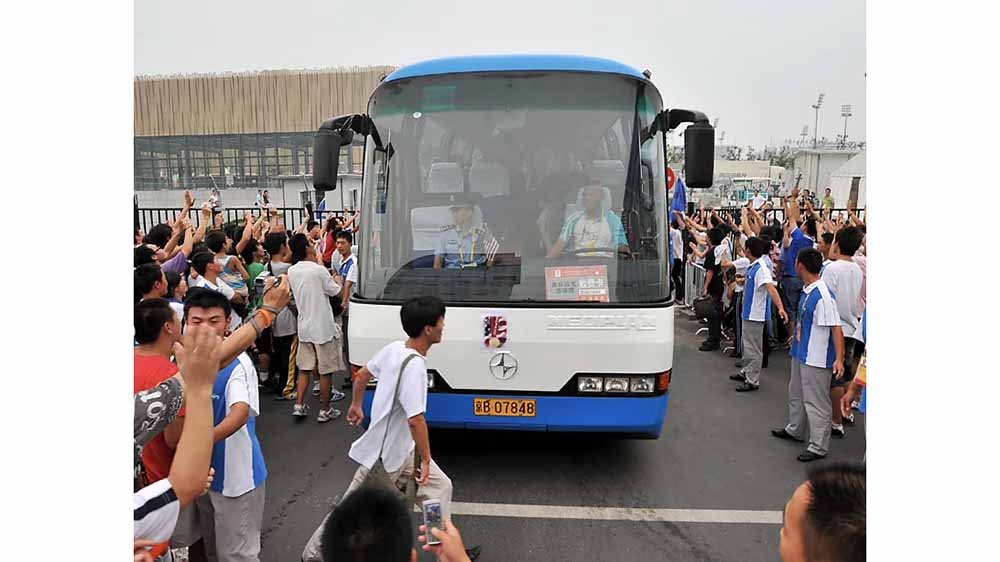
At the 2008 Beijing Olympics, athletes, journalists and officials from all over the world were transported by a fleet of sleek buses sporting a white, blue and green design as they zipped between different venues in the Chinese capital.
Different from the diesel-powered vehicles that ruled Beijing’s streets at the time, the Olympic buses, numbering around 50, ran on lithium-ion batteries to help Beijing host a “green and high-tech” Olympic Games. It also marked the country’s first foray into creating a lithium-ion battery industry for electric vehicles (EVs), laying the groundwork for China’s ascension to world leader of this technology two decades later. The Olympic e-bus campaign had been set in motion as soon as Beijing won the bid in 2001, according to a 2020 documentary aired by China’s state media. But developing and producing EV batteries for the global event was no easy feat.
In late 2003, Mo Ke and his colleagues at the Beijing New Materials Development Centre – a government-affiliated research institute – were tasked to analyse China’s lithium battery industry as part of Beijing’s preparatory work for the Olympics.
But back then, China’s lithium battery industry was “very small” with only two EV battery producers, as Mo’s team found. In 2005, they hosted China’s first conference for the lithium battery industry as a part of their research.
“All companies in the industry came, but there were only around 200 people in total,” Mo says.
At the time, CATL, the world’s current largest EV battery maker, was a department of ATL, a Japanese-owned company that made lithium batteries for electronic gadgets. BYD, the world’s current second-largest EV battery maker and a leading EV maker, had just entered the auto industry after earning its first barrel of capital by supplying batteries to phone giants. Twenty years later, China is the king of the industry indispensable to the world’s 2050 net-zero goal. It produces more than three-quarters of all lithium-ion batteries worldwide and is home to six out of the 10 largest battery makers on the planet.
Two of them are a huge domestic market “walled off and preserved” for local firms and coordinated government support across the supply chain, says Xie Yanmei, an independent analyst of Chinese political economy and industrial policy. Consumer subsidies, state-sponsored rollout of charging networks and a policy mandating automakers to make EVs also helped, she notes.
But policy is only part of the story. Chinese companies also proved adept at large-scale production and controlling cost – both key to EV battery manufacturing.
“They have strong survival instinct and will proactively explore new ideas to help them stay competitive,” says Song Xin, who advises Chinese companies ranging from car to robot makers aiming to go global. “This is the foundation of the industry’s continuous growth.”
The story of lithium batteries began beyond China’s shores about 50 years ago with three chemists: British-American Stanley Whittingham, American John Goodenough and Japanese Akira Yoshino.
Their separate research – which earned them a joint Nobel Prize in 2019 – rode on each other’s strength and led to the invention of the first commercially viable lithium-ion battery in 1985, built by Yoshino for Tokyo-based chemical company Asahi Kasei. In 1991, Japanese electronics company Sony worked with Asahi Kasei to bring the world’s first lithium-ion batteries to the market. Five years later, Nissan teamed up with Sony to launch the world’s first car powered by a lithium-battery. (BBC)
In the following decade, Japan was the global number one lithium-ion battery producer, with South Korea keenly vying for supremacy. At the turn of the century, Japanese firms accounted for a staggering 93% of the global market share, with electronics company Sanyo leading the charge. It wasn’t until 2011 that South-Korean Samsung SDI overtook Japanese Panasonic to top the chart.