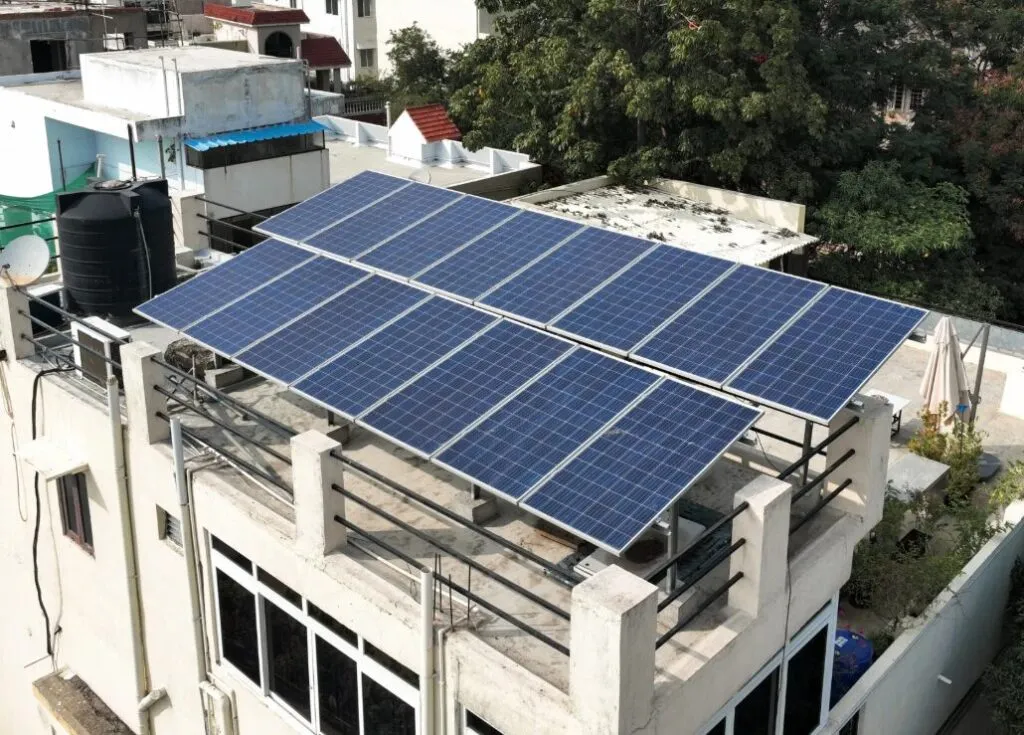
NEW DELHI, JUN 23 (PTI): While India is quickly expanding its rooftop solar capacity, the growth is deeply lopsided — much of the increase has occurred in western and southern states, but large parts of the east and northeast still lag far behind, according to a new analysis.
As of March, the rooftop solar capacity in Gujarat, Maharashtra and Kerala stood at 6,882 MW, 5,442 MW and 1,850 MW respectively. However, in Odisha, West Bengal, Jharkhand and Assam, it was at 156 MW, 67 MW, 95 MW and 344 MW respectively.
The issue needs to be tackled because if India wants to meet its commitment of a 47-per cent cut in the emissions intensity of the GDP and 60 per cent non-fossil-installed power capacity by 2035, every state would have to expand its rooftop solar capacity.
“Rooftop solar is among the fastest ways to add clean capacity close to where demand sits, without new land or transmission lines, but only if adoption spreads,” said the analysis — “India’s rooftop solar boom is real, and deeply lopsided” — by Climate Compatible Futures (CCF), a Bengaluru-based research and consulting organisation.
India’s cumulative rooftop capacity reached 25.7 GW by March and installers added 2.7 GW in the first quarter of 2026 alone, a 125-per cent jump over the same quarter a year earlier.
According to the authors of the analysis, western and southern states like Gujarat, Maharashtra and Kerala have done well as they built installer networks, financing channels and consumer awareness years ago.
Another reason is that their distribution companies (DISCOMs) tend to process net-metering applications quickly and view rooftop solar as an asset.
Net metering is a billing mechanism that credits solar-energy system owners for the electricity they add to the grid.
Eastern and northeastern states have so far failed to expand their rooftop solar capacity due to several factors, the analysis said.
“In much of the east, financially-stressed distribution utilities are slower and more cautious, the vendor base is thin and households face weaker access to credit and lower awareness of the subsidy, barriers that analysts say keep adoption low even where the policy and the potential are both present,” it added.
In the northeast, finance may not be an issue as Assam offers a combined central-plus-state subsidy and the region’s states qualify for higher central assistance than the rest of the country.
The uptake could be low due to thinner utility capacity, slower approvals, limited financing and vendor networks, and low consumer awareness rather than the size of the cheque, according to the analysis.
In a statement, Dr Manish Ram, chief executive officer of CCF, said, “India’s 2035 targets assume every state pulls its weight, and that will not happen on subsidies alone. The states falling behind need functioning distribution utilities, local vendors and consumers who trust that the savings will actually show up on their bills. That might be a question of execution, not ambition.”