THIRUVANANTHAPURAM, MAY 17 (PTI): Buoyed by its victory in three seats in the April 9 Kerala Assembly elections, the BJP has unveiled a 13-point political agenda that it said would shape its strategy in the state ahead of the next Lok Sabha elections.
The agenda places a clear focus on consolidating support among Hindu backward communities while recalibrating the party’s outreach to minority groups.
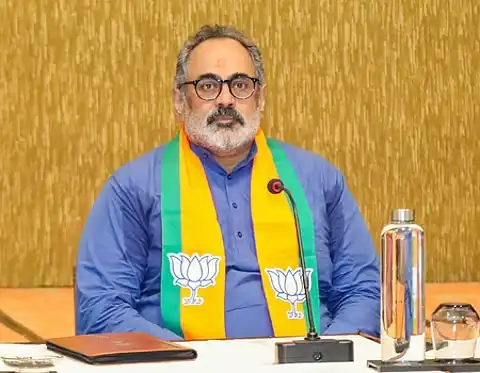
The agenda was part of a political resolution adopted at a BJP state core committee meeting held on Saturday and chaired by state president Rajeev Chandrasekhar, a party source said.
According to the source, the party’s document does not explicitly outline fresh outreach initiatives towards minority communities, particularly Christians, despite earlier attempts to build closer ties with the community ahead of the Assembly elections.
Those efforts, however, were not sustained for various reasons, the source added.
Regarding minority outreach, the source stated that the party has not discontinued its engagement with the Christian community, noting that its members continue to hold organisational positions in several districts.
However, it has moved away from attempts to build institutional bridges with Church leadership amid the growing political alignment of bishops with the Congress-led UDF.
The informal shift, according to party insiders, followed the Catholic Church’s strong opposition to the Centre’s move to introduce the contentious Foreign Contribution (Regulation) Act (FCRA) Amendment Bill, 2026, in Parliament—a development that put the BJP on the defensive during the Kerala Assembly election campaign.
At the same time, the BJP’s agenda places sharper emphasis on Hindu backward communities, particularly through its position on OBC reservation, stating that it should not be implemented under the guise of religious reservation.
The party is seen as attempting to strengthen its outreach to key social groups, including the numerically significant Ezhava community, which remains a crucial support base for the state’s two major Left parties, the Communist Party of India (Marxist) and the Communist Party of India.
On reservations, the BJP said that “religious reservation under the guise of OBC reservation should be completely abolished” and that reservation policies should be restricted to OBC, SC/ST and EWS categories.
The resolution further stated that no group should receive preferential treatment through “appeasement” and stressed the need for equal opportunities for all Malayalis.
“The BJP will not allow backward class reservation to be turned into religion-based reservation,” Chandrasekhar said, highlighting the issue as part of the party’s efforts to further expand its outreach among backward Hindu communities.
The party alleges that a section of the minority community receives a reservation under the OBC category and argues that this practice should be ended.
“Reservation is meant for SC, ST and OBC communities. The BJP will fight against any attempt to convert it into a religion-based reservation to the fullest extent. Our policy is justice for all, appeasement for none.
If the state government, under pressure from the Muslim League and Jamaat-e-Islami, adopts appeasement politics, the BJP will strongly oppose it,” Chandrasekhar said.
The resolution further reiterates the party’s core Hindutva positioning by raising the Sabarimala issue and calling for an audit of temple properties and assets, underscoring its continued emphasis on religious and cultural mobilisation alongside its social outreach strategy.
The party called for legal action in connection with the alleged “Sabarimala gold looting”, sought a CBI probe, and demanded the withdrawal of all cases registered during the Sabarimala women’s entry protests.
The BJP also called for an audit of temple properties and assets, stronger investment in schools and colleges, and measures to protect children from the influence of “religious fundamentalist organisations, terrorist organisations, and drugs”.
The party said that a “third alternative” to the CPI(M)-led LDF and Congress-led UDF had now emerged in the state, claiming that voters had accepted the rise of a new political force.
In a post-poll assessment, the party said the NDA had won three Assembly constituencies, finished second in six others, and secured around 30 lakh votes in Kerala.
The BJP state leadership expressed gratitude to voters across the state, saying their support had helped the NDA achieve what it described as a significant milestone in its growth in Kerala.
The party said the NDA would function as a “true people’s opposition” in Kerala, focusing on raising key political and public issues affecting people within the legislature.
However, despite winning three seats in the Assembly elections, the BJP did not record a significant increase in its vote share compared to the 2021 polls, according to Election Commission data.
The party secured 11.42 per cent of the vote (24,66,178 votes) in 2026, slightly higher than the 11.30 per cent (23,54,468 votes) it secured in 2021, falling short of its stated target of crossing the 20 per cent mark to emerge as a major political force in the state.