
Mediators moved closer Wednesday to extending the ceasefire between the United States and Iran and restarting negotiations to salvage the fragile truce before it expires next week.
A senior Iranian military official threatened to halt trade in the region if the US does not lift its naval blockade, underscoring tensions that are overshadowing the diplomacy.
The US blockade on Iranian ports and renewed Iranian threats have imperiled the week-old agreement, but regional officials said Wednesday they were making progress, telling The Associated Press that the United States and Iran had given an “in principle agreement” to extend it to allow for more diplomacy.
The commander of Iran’s joint military command warned Wednesday that Iran would completely block exports and imports across the Persian Gulf region, the Sea of Oman, and the Red Sea if the US military does not lift its blockade on Iranian ports.
“Iran will act with strength to defend its national sovereignty and its interests,” said Ali Abdollahi, calling the blockade “a prelude to violating the ceasefire.” His comments were reported by Iranian state media. Before the two-week ceasefire expires on April 22, mediators are pushing for a compromise on three main sticking points that derailed direct talks last weekend — Iran’s nuclear program, the Strait of Hormuz and compensation for wartime damages — according to one of the regional officials who is involved in mediation efforts.
Both officials spoke on condition of anonymity to discuss the matter. World leaders including US President Donald Trump and UN Secretary-General António Guterres said on Tuesday that revived talks in the upcoming days were likely.
The fighting has killed at least 3,000 people in Iran, more than 2,100 in Lebanon, 23 in Israel and more than a dozen in Gulf Arab states. Thirteen US service members have also been killed.
Prospect for more talks as blockade threatens escalation
The war, now in its seventh week, has jolted markets and rattled the global economy as shipping has been cut off and airstrikes have torn through military and civilian infrastructure across the region. Oil prices fell on hopes for an end to fighting on Wednesday, and US stocks surged close to records set in January.
Yet whether the fragile ceasefire would hold appeared increasingly uncertain as the US pressed ahead with its blockade, which threatens to sever Iran from economic lifelines it has relied on since the war began nearly seven weeks ago.
“I think they want to make a deal very badly,” Trump said in an excerpt from an interview with Fox Business Network’s “Mornings with Maria” scheduled to air Wednesday morning. He added: “I view it as very close to over.”
A US official said Tuesday that fresh talks with Iran were still under discussion and that nothing has been scheduled. The official spoke on condition of anonymity because they were not authorized to discuss sensitive negotiations.
Muhammad Aurangzeb, Pakistan’s finance minister, told The Associated Press that “our leadership is not giving up” on efforts to help the U.S. and Iran end the conflict.
Trump on Wednesday claimed that China has agreed not to provide weapons to Iran as reports circulate that Beijing has considered transferring arms.
Trump wrote in a social media post that China is “very happy that I am permanently opening the Strait of Hormuz.” He added: “They have agreed not to send weapons to Iran.” He seemed to suggest the two are linked.
China has long supported Iran’s ballistic missile program and backed it with dual-use industrial components that can be used for missile production, according to the US government.
Tankers turned around after blockade took effect
US Central Command said Tuesday no ships made it past the blockade in the first 24 hours, while six merchant vessels complied with direction from US forces to turn around and reenter Iranian waters.
The blockade is intended to pressure Iran, which has exported millions of barrels of oil, mostly to Asia, since the war began Feb. 28. Much of it has likely been carried by so-called dark transits that evade sanctions and oversight, providing cash that’s been vital to keeping Iran running.
Tankers approaching the strait Monday turned around shortly after the blockade took effect, though one reversed course again and transited the waterway.
Since the war began, Iran has curtailed maritime traffic, with most commercial vessels avoiding the waterway. Tehran’s effective closure of the strait, through which a fifth of global oil transits in peacetime, has sent oil prices skyrocketing, pushing up the cost of gasoline, food and other basic goods far beyond the Middle East.
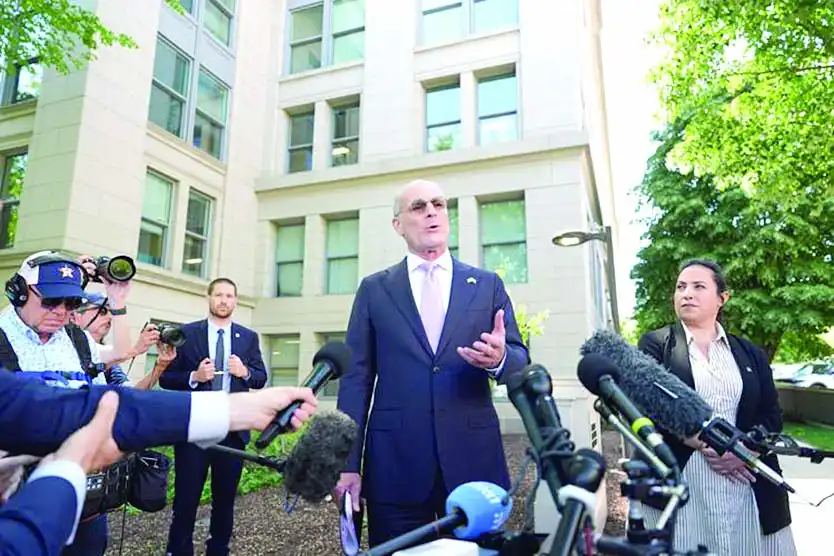
Mediators closer to US-Iran CF: Official
Cairo, Apr 15 (AP):